

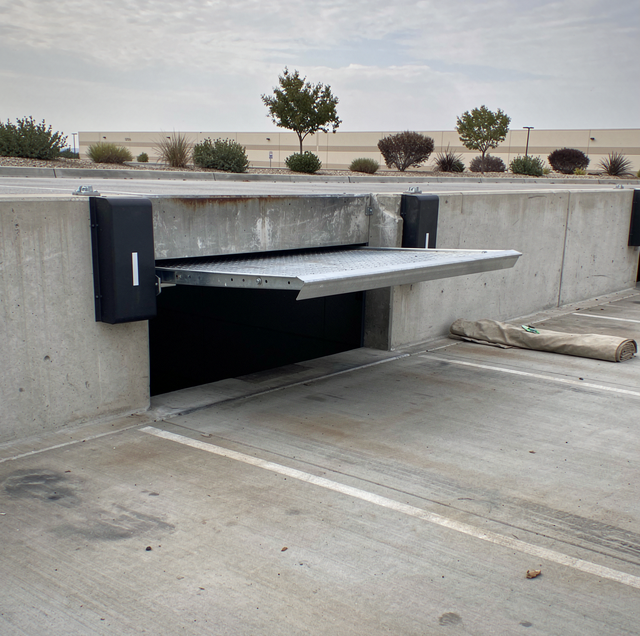
An edge-of-dock leveler is a short plate bolted to the dock face rather than set into a pit. The unit pivots the plate up; a hinged lip at the front swings out, and the lip is designed to lower and rest flat on the trailer bed so the plate bridges the step at the open door. When the lip swings out and stays in the air without settling, either the trailer sits outside the unit's reach, or something in the hinge, the lip, or the spring that drives it is holding it back.
Each thing a dock crew sees at the leveler matches a likely cause:
| What the crew sees | Likely cause |
|---|---|
| Lip extends and hangs level in the air | Trailer bed sits outside the unit's working range |
| Lip drops on some trailers, not others | Bed height variation between loads, or a gap the bumpers no longer hold correctly |
| Lip moves stiffly and stops partway | Seized or fouled hinge |
| Lip sits bent or twisted | Impact damage to the lip or hinge |
| Plate itself will not rise far enough | Weak counterbalance spring, or on a powered unit, the cylinder |
Trailer Bed Height Against the Unit's Working Range
Every edge-of-dock unit is built to reach a set band of height above and below the dock floor, fixed by the plate's size and the hinge geometry, and nothing a crew can adjust in the field changes it. When a trailer's bed sits above or below that band, the lip swings out on schedule, but the geometry runs out before it reaches the bed, so it hangs in open air over the gap. Refrigerated trailers, flatbed conversions, and standard dry vans do not all sit at the same height, and the same dock position can present the unit with beds on opposite sides of its limit depending on which trailer backs in. For a lip that is out of reach on one specific trailer, a working-range mismatch is the first thing to rule out before touching the hinge or the springs.
The Gap from Trailer to Dock Face
The lip is also built to close a specific horizontal gap, the distance between the dock face and the trailer's back end, and that distance is set by whatever stops the trailer's approach. A trailer parked farther out than that stop allows stretches the lip past where it can reach, even when both the unit and the trailer height are within range. Worn or uneven bumpers change where a trailer stops, closer against a worn pad or at an angle against an uneven pair, and either one throws off the gap the lip is built to span.
A Seized or Fouled Lip Hinge
The lip pivots on a hinge pin exposed at the dock face, where it collects grit, packaging debris, and dust blown in off the yard. Debris packed into the hinge channel keeps the lip from swinging its full arc, so it stops partway, short of the bed. Corrosion works the same way from the inside: rust builds up between the pin and its bushing, the clearance closes, and a hinge that used to swing freely now drags or locks in place. A hinge that has gone dry adds a third path to the same result. Without lubrication, friction at the pivot increases until the force behind the lip is no longer sufficient to complete the swing.
A hinge that only needs cleaning and grease can move freely again once it is serviced; one that has pitted or worn oversized from corrosion needs the pin or bushing replaced, because clearance that has already opened will not close back down with grease.
A Bent Lip or Hinge After an Impact
A forklift catching the lip on the way in, or a trailer backing against it before the plate is retracted, can bend the lip itself or the hinge bracket that carries it. Bent metal changes the geometry the hinge was built around, so the lip no longer swings through the same arc, and it can bind partway, hang at an angle, or clear the hinge pin but land twisted on the bed. A twisted lip that does make contact with the trailer bed touches down on one edge alone, which is its own hazard, because the load path the lip is supposed to spread across its whole face is now carried by a narrow strip of metal. Impact damage is visible on the lip's edge or the bracket itself, distinct from the gradual wear of a fouled hinge, and it does not resolve with cleaning or lubrication.
The Counterbalance Spring or, on a Powered Unit, the Cylinder
A mechanical edge-of-dock leveler holds the plate up and the lip extended with a counterbalance spring, the same kind of stored-energy component that does the lifting on a pit-style mechanical leveler. As that spring loses tension with age and cycling, it can no longer hold the plate at full height or carry the lip through its full arc, so the lip may swing partway and settle back. A powered edge-of-dock unit uses a small hydraulic or electric cylinder in place of the spring to extend the lip; when that cylinder loses pressure or power, the result looks the same from the dock floor: a lip that will not finish its motion, even though the cause sits in a different system entirely.
A lip resting on air or on one edge can give way under a forklift, dropping the forklift and its driver into the gap between the dock and the trailer; a technician frees a stuck lip while the trailer remains restrained and chocked.
Repair, Parts Replacement, or a New Unit
Nobody stands on a stuck lip, reaches under the plate, or forces the lip down with a forklift or a bar to free it, and a powered unit is locked out before anyone touches the hinge. A seized hinge that only needs cleaning and grease is a plain repair. Replacing a counterbalance spring or cylinder is a more extensive repair, and it is worthwhile as long as the plate, hinge, and mounting frame are still sound. A bent lip or hinge bracket is a judgment call: a bracket that has already deformed once carries less margin against the next impact, which is a real consideration even when it can be pulled back into a workable shape. A plate whose mounting frame has been struck and pulled away from the dock face is where a new unit becomes the straighter path, because a frame that no longer holds true undermines every repair made to what is bolted onto it. A working-range mismatch is different from all of these: if the trailer mix a dock loads has moved outside what an edge-of-dock unit can reach, no repair to the existing unit closes that gap, and the fix is matching the equipment to the trailers.
Frequently Asked Questions
The same parking spot can accommodate different trailer beds at different heights because a trailer's height varies with how it is loaded. An empty trailer rides higher on its suspension than one carrying a full load, and that shift alone can move a bed from inside the unit's working range to just outside it. A crew that sees the lip drop cleanly on a loaded trailer and hang in the air on the next empty one is watching that same shift.
No. A lip that moves and stops partway is still receiving force from the spring or cylinder, and something in its path, debris or corrosion, is fighting that force to a stall. A lip that never leaves its stored position has a different fault: the lift force is not reaching it due to a spring that has let go, a broken linkage, or a cylinder with no pressure or power behind it. Partial motion sends a technician to the hinge and the spring first; no motion at all sends them to the spring, linkage, or cylinder circuit.
Sometimes. Steel forced past its working shape keeps a slight permanent set even after it is bent back, so a straightened lip can still meet the trailer bed on one edge. A lip or bracket that will not come back flat and square to the hinge is replaced, since the rest of the plate depends on that hinge geometry.
The spring offsets the weight of the plate and lip, which allows one person to swing the unit out with its handle. As it weakens, the handle requires more effort before the lip reaches full extension, and a crew feels a heavier pull before the lip starts to stop short.
Yes, once someone is close enough to look. A hinge fouled with debris or corrosion can stick at the same point in the swing on every cycle, and the lip that does complete its arc lands in the same position it always has. A bent lip or bracket looks different: the lip sits visibly out of line with the plate or the dock face even when fully extended, and it can scrape or grind against the hinge housing at a point that had no contact before the impact.
Yes. On a mechanical unit, the handle is the lever that rotates the plate and carries the lip through its arc, and a handle bent by a forklift strike, or a worn pivot at its socket, can run out of travel before the lip clears the trailer's rear edge. The plate then stops short with the springs and hinge sound.
Reserve edge-of-dock leveler repair — hinge and lip service, counterbalance spring and cylinder repair, and a working-range match against your trailers. Prime Dock & Door LLC serves La Mirada, Anaheim, and Santa Ana. Call (714) 683-2201.