

Commercial Door Spring Failing Signs: 7 Red Flags
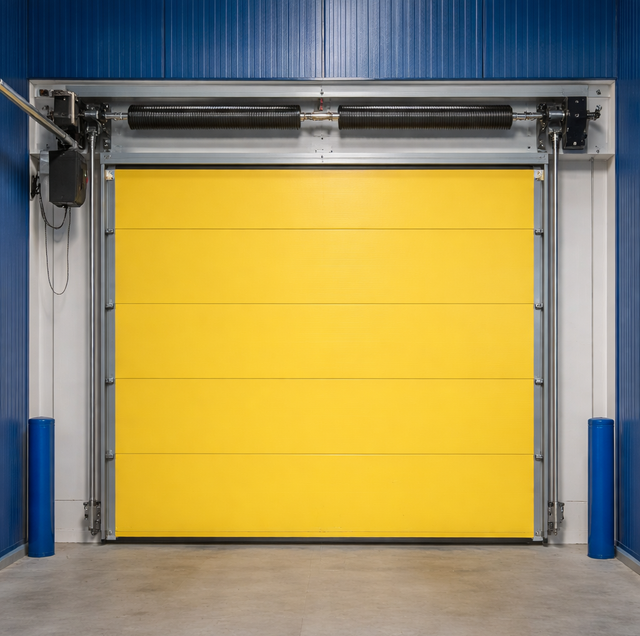
Quick Answer: A failing commercial door spring usually announces itself before it breaks: the door feels much heavier, the opener strains or stalls, travel goes jerky or crooked, or you spot a gap in a coil, rust, or slack cables. Take the door out of service and call a trained technician. The springs are under extreme tension and are not a staff or DIY repair.
A commercial overhead door is one of the heaviest moving objects in your building. A sectional dock door can weigh several hundred pounds, and a large insulated unit can top 600 to 800 pounds. Almost none of that weight is lifted by the motor. The motor only nudges the door along once something else has already canceled out the load. That something is the torsion spring, and when it starts to give out, the whole operation is riding on a part that is quietly wearing toward failure.
Knowing the warning signs lets you pull a door out of service on your own schedule instead of during a shift, with a truck backed up to the dock and freight waiting.
How A Torsion Spring Actually Holds The Door Up
The torsion spring sits on a shaft above the door opening. As the door closes, cables wind the spring tight and store energy in the coiled steel. As the door opens, the spring releases that energy and returns it to the cables and drums, which pull the door upward. Sized correctly, the spring offsets nearly the full weight of the door, so at any point in its travel the door is close to balanced and wants to hang still rather than fall.
A well-balanced door is a lot like a loaded dumbwaiter running on a counterweight: the mass on one side is canceled by stored force on the other, so only a light push is needed to move it. The opener supplies that light push and controls speed and stopping. The spring carries the weight. Once you separate those two jobs in your head, most spring symptoms make sense, because they all trace back to the counterbalance weakening while the motor is left holding a load it was never built to hold.
Why Commercial Springs Wear Out Faster Than Residential Ones
A torsion spring is rated in cycles, where one cycle is a full open and close. A common residential spring is rated for roughly 10,000 cycles. A house door that opens four or five times a day may take a decade to reach that number.
A commercial dock door lives a different life. A busy warehouse door can open and close 50, 100, or more times a day as trucks come and go. At that pace, even a heavier-duty spring rated for 25,000 or 50,000 cycles marches through its rated life in a few years, not a few decades. High-cycle springs made from thicker wire exist for exactly this reason, but every spring has a finite fatigue life, and each cycle flexes the steel a little closer to the end of it. That is why a door running dozens of times a shift needs its springs treated as wear parts on a schedule, not as permanent hardware.
Constant duty also stacks other stresses on the steel. Heat and hard, fast cycling in the summer months work the metal, and cold mornings make the same steel more brittle, so the wear runs year-round rather than in one season. Salt-laden air near the ocean and washdown moisture speed up surface corrosion, and a pitted, rusted coil fails sooner than a clean one.
The Warning Signs A Spring Is Failing
Most spring failures give notice. The signs below tend to show up before the final break, and any one of them is a reason to stop and inspect.
The door suddenly feels much heavier: This is the clearest early sign. As a spring loses its stored force, more of the door's weight lands on the cables, the opener, and anyone who tries to move it by hand. Staff may notice the door is harder to lift manually, or a door that always coasted now needs a shove. Heaviness that appears over a few days, not a few months, points to the counterbalance.
The opener strains, slows, or stops lifting: An opener sized to nudge a balanced door cannot lift a door the spring is no longer holding. You hear the motor labor, the door crawls, it stops partway, or the opener reverses or trips its overload. Operators often blame the motor first, but a healthy motor asked to lift the door's full dead weight will strain and stall exactly like this.
Jerky, uneven, or crooked travel: When one spring in a two-spring system weakens, or a cable starts slipping off its drum, the two sides of the door no longer rise together. The door racks, cocks to one side, binds in the tracks, or moves in a stutter instead of a smooth run. Crooked travel also loads the rollers and tracks unevenly, which spreads the damage.
A loud bang from the door area: A torsion spring that breaks releases its stored energy in an instant, and it is loud, often a single sharp bang like a gunshot that staff hears from across the building. If the door still ran a moment ago and now will not lift, a spring that let go is the first thing to suspect.
A visible gap in the coil: An intact torsion spring is a continuous tight coil. A broken one shows a two- to three-inch gap where the steel separated. Looking up at the shaft above the door and seeing a clear break in the coil is a definite failure. The door must not be run.
Gaps, rust, stretching, or wear on the spring: Even before a full break, a spring nearing the end of its life can show widening gaps between coils, heavy rust, flaking coating, or visible thinning where the wire has fatigued. These are signs the steel is tired and closer to letting go than it looks.
The door drops or slams faster than normal, and slack cables: A door that comes down harder or faster than usual, or that will not hold its position partway, is telling you the counterbalance no longer offsets its weight. Cables that hang loose, that have jumped their drums, or that show fraying and kinks belong on the same list. Slack or damaged cables and a failing spring travel together, because when one lets go, the load shifts onto the other.
Strained Motor Or Failing Spring? How To Tell Them Apart
Because both problems can leave a door stuck, they get confused, but the tell is in the balance test. Disconnect the opener using its manual release so the door is on the springs alone, then move the door by hand.
If the door lifts with light effort and stays put around waist or chest height, the counterbalance is doing its job, and the fault is more likely in the opener, the drive, or the electrical side. If the door is hard to raise, drops the moment you let go, or slams down, the springs are the problem and no amount of opener work will fix it. This check should be done by someone trained, because a door with a failing counterbalance can drop hard during the test. Never leave a door disconnected and half-open where it can fall on someone.
Why Running A Door With A Bad Spring Makes It Worse
A weak or broken spring turns a balanced door into a heavy weight held up only by cables and the opener. Keep running it, and the failure spreads.
The opener takes the first hit. Gears, the drive belt or chain, and the motor were sized for a balanced load, and forcing them to lift the door's full weight strips gears and burns out motors. Cables carry the rest, and cables asked to hold a load the spring should share fray and snap. When a cable or the second spring finally lets go, the door can come down fast with nothing left to slow it. A falling commercial door is a crushing hazard to anyone below and to whatever equipment or freight sits in the opening. What began as a spring worth replacing becomes a new opener, new cables, drums, and possible impact damage.
The Downtime And Safety Cost Of A Sudden Break
A spring that snaps mid-shift stops the dock. That bay is down until a technician arrives with the right spring, trucks reroute or wait, and freight backs up behind a door that will not move. An emergency call during peak hours costs more than planned service and lands at the worst moment.
The safety exposure is the sharper cost. A door that free-falls or a cable that whips loose can injure staff and draw the kind of workplace-safety attention no facility wants. Catching the warning signs early converts an unplanned emergency into a scheduled swap done between shifts, on your terms.
This Is A Trained-Technician Job, Not A Staff Fix
Commercial torsion springs hold hundreds of pounds of force even when the door is closed. Loosening a set screw or a winding bar wrong lets that energy release at once, and the bars, the spring, or the shaft can strike with enough force to break bones or worse. This is not a task for facility staff or maintenance generalists.
If you see any of the signs above, the safe response is to stop using the door, keep people out from under it, and tag it out of service so no one runs it. Lockout and tagout should be handled by trained personnel following your facility's procedure. Then bring in a technician who services commercial doors, replaces springs in matched sets, and checks the cables, drums, bearings, and door balance while the system is open, so the repaired door leaves properly counterbalanced rather than merely running again.
Frequently Asked Questions
Spring life is counted in cycles rather than years, so the honest measure is your daily door traffic. A standard 10,000-cycle spring on a door worked 40 times a day is used up in roughly eight to ten months, while a 25,000-cycle high-cycle spring on the same door lasts closer to a year and a half. Ask your technician to match spring cycle rating to your measured daily door count rather than defaulting to standard springs.
Yes. On a two-spring door, the pair was installed together and has cycled the same number of times, so a second break is usually weeks away once the first goes. Replacing both in a matched set keeps the door balanced and avoids a second service call and a second stretch of downtime. A mismatched pair, one new and one worn, also loads the door unevenly and shortens the new spring's life.
It can. When a door racks or slams because the counterbalance is failing, the sections twist against each other, and the hinges, and repeated hard closings can bend the bottom section, split panels at the hinge line, or dent the door where it strikes the floor. That panel and hinge damage is separate from the spring itself and is a reason not to keep cycling a door that travels crooked.
Not usually on its own. A dry squeal or grinding often traces to unlubricated coils, worn rollers, or failing bearings on the torsion shaft rather than the spring's strength. It still matters, because dry, seized coils and bad bearings put extra strain on the spring and speed its wear. Periodic lubrication of the coils and bearing plates with a spray designed for door hardware, not general grease, extends spring life.
They are. Extension springs run alongside the horizontal tracks and stretch rather than twist, and they are more common on lighter doors. When an extension spring breaks, it can launch, which is why safety cables are run through them to contain the pieces. Most heavier commercial and dock doors use torsion springs on a shaft for better balance and control, but if your door has extension springs, confirm the containment cables are present and intact.
Tie inspection frequency to cycle count, not the calendar. A low-traffic door can be checked twice a year, but a door opening 50 or more times a day warrants a quarterly look at coil condition, gaps, cable wear, and balance, plus a spring count logged against its cycle rating so a replacement is scheduled before failure. A quick monthly visual glance at the coil by trained staff, looking only, never adjusting, catches a forming gap early.
Book a commercial spring inspection before the next break stops your dock — a scheduled swap beats an emergency call. Prime Dock & Door LLC serves La Mirada, Anaheim, and Santa Ana. Call (714) 683-2201.
