

Manual vs. Hydraulic Dock Leveler: Which One Fits?
Quick Answer: Manual (mechanical) levelers are spring-loaded and set by pulling a chain and walking the deck down, so they cost less upfront but need more adjustment over time. Hydraulic levelers run off a pump at the push of a button, cost more to install, and generally need less routine attention, which suits high-traffic docks.
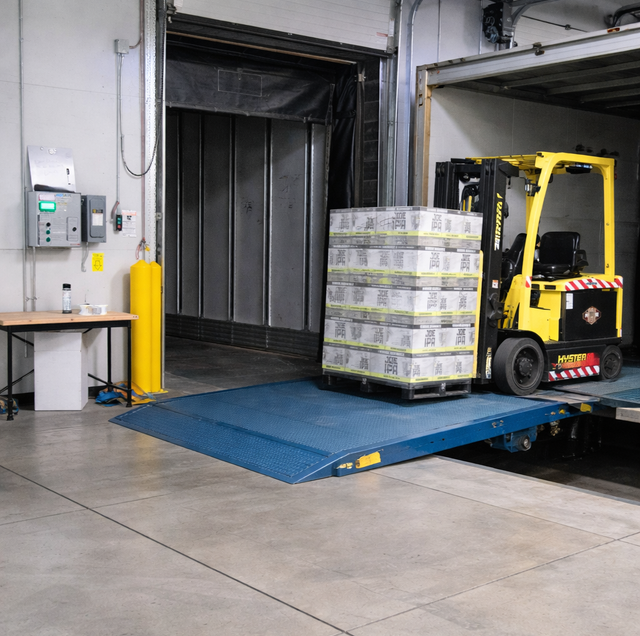
A dock leveler is the steel bridge that closes the gap between your loading dock floor and the bed of a parked trailer. Trailer beds rarely sit at the exact same height as the dock, and the height changes as a truck is loaded and the suspension settles. The leveler ramps up or down to meet that moving target so a forklift can roll across the threshold without a bounce, a drop, or a stall at the edge. Choosing between a manual (mechanical) unit and a hydraulic one shapes how hard your crew works, how much you spend keeping the dock running, and how safe that crossing feels on a busy shift.
Before the comparison makes sense, it helps to know what the leveler is actually doing under the plate.
What A Dock Leveler Does And How It Is Built
Every pit-style leveler has two moving parts that matter here: the deck (the large hinged platform your forklift drives on) and the lip (the shorter hinged extension at the front that folds out to rest on the trailer bed). When the dock is idle, the deck sits flush with the floor, and the lip hangs down inside the pit, stored. To load a truck, the deck raises, the lip swings out, and the whole assembly lowers until the lip settles onto the trailer bed, forming a continuous ramp from warehouse floor to trailer floor.
Levelers come in three main drive types. Mechanical units use springs and a hold-down mechanism and are activated by hand. Hydraulic units use a powered pump and cylinders and are activated by a button. Air-powered units sit between the two, using an inflatable airbag instead of springs or hydraulics. This article compares the two most common choices side by side, mechanical versus hydraulic, with a note on where air-powered fits.
Mechanical (Manual) Dock Levelers
A mechanical leveler stores energy in a set of large springs. To operate it, a worker pulls a release chain that lets the springs raise the deck and swing the lip out. The operator then walks out onto the deck, and their body weight, plus gravity, "walks" the platform down until the lip lands on the trailer. The hold-down mechanism catches and holds the deck at working height.
Where mechanical units make sense: The appeal is a lower purchase and installation cost, since there is no pump, motor, or electrical hookup to wire in. For a dock that sees a handful of trucks a day, that simplicity is often enough. The mechanical design has fewer powered components to fail outright.
The trade-offs: The operator does real physical work on every cycle, walking the deck down and, on some units, hauling it back up. Over hundreds of cycles, that adds up, and it is why ergonomics becomes a real issue on higher-volume docks. Mechanically, the springs are the weak point. Springs weaken with age and cycling, so the deck may stop rising to full height or stop holding position, and the tension has to be re-adjusted periodically to keep the unit working correctly. That adjustment is skilled work. A spring under load carries stored force, and releasing or setting that tension without the right tools and training is a serious injury hazard, so spring service belongs with a technician, not a general maintenance hand.
Hydraulic Dock Levelers
A hydraulic leveler replaces the springs and manual effort with a powered system. An electric pump pressurizes hydraulic fluid, and cylinders raise the deck and extend the lip. The operator holds a button; the deck rises, the lip swings out, and releasing the button lets the deck settle onto the trailer under controlled hydraulic pressure. No one walks the platform down, and no chain gets pulled.
Where hydraulic units make sense: Push-button operation is faster and smoother, and it takes the physical strain off the operator, which matters most on docks cycling dozens of trucks a day. Because the motion is powered and consistent rather than depending on a worker's weight and technique, the crossing tends to be more repeatable. Many hydraulic units also offer automatic or single-push sequencing, where one press runs the full raise-extend-lower cycle. For heavy loads and frequent use, that consistency and reduced labor are the core reason operations move to hydraulic.
The trade-offs: The upfront investment is higher because you are buying a pump, cylinders, and the electrical work to power them. In exchange, there are no springs to weaken and re-tension, so routine long-term maintenance is generally lighter and more predictable, mostly checking fluid, seals, and hoses rather than chasing spring adjustment. A leaking seal or hose is the kind of issue that shows up, and it is why the safety systems below matter regardless of drive type. Powered convenience is not a substitute for the mechanical safeguards.
Choosing between the two is less about which is "better" and more about matching the tool to the shift, the same way a shop picks a hand truck for a light delivery run and a powered pallet jack for a warehouse floor: both move freight, but the volume and pace decide which one earns its keep.
Where Air-Powered Levelers Fit
Air-powered levelers use an inflatable bag driven by a blower motor to raise the deck, then the lip extends, and the unit lowers onto the trailer, again at the push of a button. They give you powered, low-effort operation like a hydraulic unit but without hydraulic fluid in the system, which appeals to operations that want to avoid the possibility of a fluid leak near product. They sit as a middle option: more automated than a manual spring unit, with a different maintenance profile than hydraulic. For most dock managers, the real decision still comes down to mechanical versus hydraulic, with air-powered considered when a specific site condition points to it.
The Decision Factors That Actually Decide It
A few practical questions sort most docks toward one type:
- Traffic volume: A low-volume dock turning a few trailers a day can run a mechanical unit comfortably. A busy distribution center cycling many trucks per hour leans hydraulic, where speed and low operator effort compound across the day.
- Load weight and frequency: Heavy, constant loading favors a powered unit that repeats the same controlled motion every cycle without depending on operator technique.
- Operator safety and ergonomics: If your crew is walking mechanical decks down all shift, the physical toll and the injury exposure are real reasons to move to push-button operation.
- Budget: Mechanical wins on upfront cost. Hydraulic generally wins on lower and more predictable maintenance spending over the equipment's service life, so the honest comparison is total cost across years, not just the day of install.
- Maintenance capacity: Springs need periodic skilled adjustment. If you would rather have fewer, more predictable service touchpoints, a powered unit fits that preference.
- Features: Automatic sequencing, weather sealing, and integration with restraints and controls are more commonly available on powered units.
Safety Features That Belong On Both
Drive type does not change the fact that a raised steel deck stores a lot of potential energy. Several protections should be present and functional on either kind of leveler.
Free-fall (velocity-fall) protection: If a trailer pulls away early or the deck loses support, this feature is designed to catch the platform and stop a sudden drop instead of letting it slam down. It is one of the most important safeguards on the unit and should never be defeated.
Lip control: The lip should extend and retract in a controlled way and seat properly on the trailer, not flop or fall unpredictably.
Before anyone works underneath a raised leveler, the maintenance strut must be engaged to physically hold the deck up. A dropping deck can crush a person, so never trust hydraulics, springs, or an airbag alone to hold the platform while you are under it. The strut is the mechanical backstop that does not depend on pressure or a chain.
Trailer restraint or wheel chocks. Separate from the leveler itself, a truck restraint that hooks the trailer's rear impact guard, or wheel chocks placed against the tires, keeps the trailer from creeping forward or departing while a forklift is still crossing. Trailer separation during loading is among the most dangerous dock events, and this control prevents it.
Keeping the leveler working within its rated load range and lip reach, rather than stretching it to serve trailers it was not sized for, keeps all of these safeguards doing their job.
Matching The Leveler To Your Operation
A dock that handles a few local deliveries, has staff who are not straining to operate it, and runs on a tight equipment budget is well served by a mechanical unit, provided the springs are kept adjusted and the safety features are maintained. A facility running continuous inbound and outbound freight, heavy pallets, and shift-long forklift traffic gets its money back from a hydraulic unit through speed, consistency, and less wear on the people operating it. When a specific concern like fluid near product points elsewhere, air-powered is worth a look. Whatever the drive type, the maintenance struts, free-fall protection, and trailer restraint are not optional add-ons; they are the difference between a routine crossing and a serious incident.
The clean way to decide is to describe your busiest normal day, not your slowest, then match the leveler to that pace: a mechanical unit for a few local deliveries where staff is not straining, a hydraulic unit for continuous heavy freight and shift-long forklift traffic.
Frequently Asked Questions
A well-maintained pit leveler commonly serves 10 to 15 years or more, but service life is driven by cycle count, not just age. A unit cycling 50 times a day ages far faster than one cycling five times a day, which is why two identical levelers installed the same week can be in very different condition years later. Cycle frequency, load weight, and whether adjustments were kept up all matter more than the number on the calendar.
The units described above are pit-style, recessed into a formed pit in the dock floor and offering a longer deck and wider working range. An edge-of-dock (EOD) leveler is a smaller unit bolted to the face of the dock that flips out a short ramp to the trailer. EODs cost less and install faster but handle a narrower height range and lighter, less frequent traffic, so they suit docks where trailer heights stay consistent.
In many cases, yes, retrofit conversions exist, but it is rarely a simple swap. The pit dimensions, deck condition, and available electrical service all have to support the new drive, and sometimes replacing the whole unit is more cost-effective than converting an aging frame. A dock technician should assess the existing pit and structure before you assume a conversion is the cheaper path.
Working range is how far above and below dock level the leveler can safely reach while still forming a stable ramp. A common figure is roughly 12 inches above and 12 inches below dock height. Pushing a leveler past its range, to reach an unusually high or low trailer, creates a steep grade that strains forklifts and defeats the smooth crossing the leveler exists to provide.
Plan on a professional inspection at least once or twice a year for a moderate-use dock, and more often for high-cycle operations. Between visits, a quick daily look for a lip that will not seat, unusual noise, slow or jerky motion, or fluid on the pit floor catches small problems early. Mechanical units specifically need their spring tension and hold-down checked as part of that service.
Because a hydraulic unit depends on an electric pump, a full power loss can take it out of service until power returns, unlike a mechanical spring unit that needs no electricity to operate. Facilities that cannot afford dock downtime often address this by putting docks on backup power or keeping at least one non-powered position available, which is a real planning point when a site loads through outages.
Ready to spec the right leveler for your dock — get an on-site assessment that matches the unit to your real traffic and load. Prime Dock & Door serves La Mirada, Anaheim, and Orange County. Call (714) 683-2201.
