

Signs Your Dock Seals or Shelters Are Failing: 9 Warning Cues
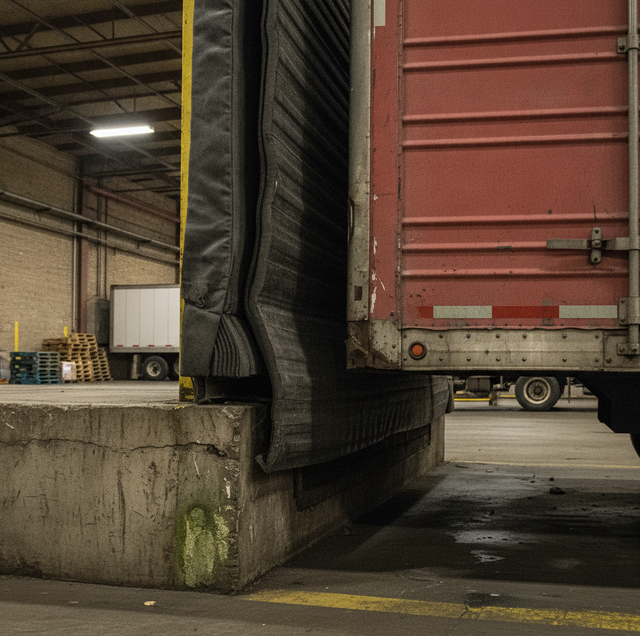
A dock seal or shelter has one job: close the gap between a parked trailer and your building while goods move across the threshold. When it works, you barely notice it. When it starts to fail, the signs show up as a draft on the warehouse floor, a light bill that keeps climbing, or a bird that somehow got into the staging area overnight. For a facility running dozens of trailer cycles a day, those small cues add up to real cost and real risk.
The trouble is that seals and shelters wear slowly. A crew loading and unloading all shifts rarely notices the day-to-day decline, and by the time the gap is obvious, conditioned air has been leaking for months. Knowing what a failing seal actually looks like, and how to tell genuine failure from ordinary cosmetic wear, lets a facility manager act before a minor repair becomes a full dock-position shutdown.
How a Dock Seal or Shelter Is Supposed to Work
Start with the two designs, because they fail in different ways and get repaired differently.
A dock seal is built from compressible foam pads mounted around the dock opening, usually two side pads and a head pad. When a trailer backs in, its rear frame presses into that foam and squashes it flat. The foam pushes back, and that spring pressure is what closes the gap. Seals give the tightest fit, but they only work well when the trailers you receive are a consistent size, because the foam is sized for a particular range of trailer heights and widths.
A dock shelter works on a different principle. Instead of foam, the trailer crushes, a shelter uses a rigid frame with fabric curtains or flaps that drape into the opening. The trailer noses in, and the side curtains and head curtain fold against it, sealing around whatever shape shows up. A shelter tolerates a much wider mix of trailer sizes than a seal does, which is why high-variety docks lean on them.
Think of the difference the way you'd think about a firm memory-foam pillow versus a heavy stage curtain: the pillow presses back with its own body, while the curtain simply drapes to fit whatever leans into it. Both keep the opening covered, but one depends on the foam springing back, and the other depends on the fabric staying whole. That distinction matters because it tells you what to inspect.
The Warning Signs a Seal or Shelter Is Failing
Once you know how the closure is supposed to happen, the failure signs read clearly. Watch for these:
- Foam that stays flat: Healthy pads spring back to full thickness after a trailer pulls out. Pads that stay crushed, dented, or dished no longer make contact pressure, so they leave a gap even when the trailer is parked correctly.
- Torn, split, or missing curtains and flaps: On a shelter, ripped fabric or a flap that has torn loose stops sealing along that edge. A missing head curtain is a common one, since the top of the opening takes the most abuse.
- Daylight around a docked trailer: Stand inside at a loaded dock and look at the edges of the opening. If you can see outdoor light tracing the trailer, weather and pests have the same path in.
- Drafts, rain, or snow reaching the floor: Air movement or moisture near an occupied dock is a direct symptom that the closure has quit.
- Climbing energy bills: Conditioned air escaping through worn seals forces heating and cooling to work harder. A creeping utility trend with no other explanation often points back to the docks.
- Pests or birds getting inside: A torn curtain or gapped pad is an open invitation for rodents, insects, and birds while a trailer is docked.
- Worn or frayed head curtains: The top closure wears fastest because trailer roofs vary most in height. A shredded head curtain is often the first fabric to go.
- Exposed or rotting backer boards: Seals and shelters mount to wood or composite backer boards. When the foam or fabric abrades away, the backer gets exposed, takes on water, and rots, which loosens the whole assembly.
- Fasteners pulling loose: Mounting hardware that has worked free, or brackets that sag, means the assembly is no longer held tight to the wall, and the seal line is compromised.
Abrasion from repeated trailer contact ties most of these together. Every dock cycle drags the trailer frame across the foam or fabric, and that grinding is what eventually wears through the face material and exposes what's behind it.
Telling Real Failure From Ordinary Wear
Not every scuff means a seal has failed. A dock seal is a wear part, and cosmetic marks are normal. The question that separates a cosmetic issue from a true failure is simple: Is the closure still closing the gap?
Surface scuffing, faded fabric, minor edge fraying, and light abrasion marks are ordinary wear. The pad still springs back, the curtain still drapes against the trailer, and no daylight shows through. That seal has cosmetic age but is doing its job.
A seal has actually failed when the gap reappears with a properly parked trailer. Compression-set foam that won't rebound, a curtain torn far enough to leave an open edge, a rotted backer that lets the assembly sag, hardware pulled loose so the pads no longer sit square: those change the geometry of the closure, and the gap comes back. Daylight, drafts, and moisture at a correctly docked trailer are the telltale signs. When you see those, the seal is not merely worn; it has stopped sealing.
What Failing Seals Signal Beyond Themselves
A worn seal is sometimes a symptom of a problem elsewhere on the dock. If one position chews through seals far faster than its neighbors, the trailers likely aren't seating square against it. Worn dock bumpers are a frequent culprit: as the rubber bumpers compress and thin with age, the trailer parks closer or at an angle, and the seal takes contact it was never meant to take. Trailer approach angle, a settled dock apron, or a leveler out of adjustment can do the same.
So when you catalog seal failures, note *where* they cluster. Even wear across all positions points to normal service life. Lopsided wear at one or two dock points to alignment, bumpers, or the dock structure, and replacing the seal alone will just wear out the new one on the same schedule.
Why Failing Dock Seals Are Worth Acting On
The costs of a failed seal stack up in more than one column.
Energy: Every open gap at a docked trailer bleeds conditioned air. Across a bank of docks and a full season, the lost heating and cooling is one of the higher hidden costs of a neglected seal line.
Product and process: Wind-driven rain, blowing snow, and outside humidity reach staged goods and the dock floor. For temperature-sensitive or moisture-sensitive freight, that exposure is a direct threat to product condition.
Contamination and pests: An open seal is an entry point for birds and rodents, which is especially critical in food, pharmaceutical, and other regulated facilities, where a pest sighting can trigger a compliance issue.
Worker comfort and safety: Crews working on an open, drafty dock face the weather all shift. And a seal component that has torn loose near a moving trailer or an operating leveler is a physical hazard in a zone that is already among the most dangerous in any warehouse.
That last point is why dock seal and shelter work belongs with a professional. The job puts people at the dock edge, often on ladders or lifts, around heavy trailers and powered equipment. Assessing a failing seal, especially one flapping loose near an active dock position, is not a task to improvise from the warehouse floor.
Matching the Fix to the Failure
Repairs follow the diagnosis. Compression-set foam pads get replaced. Torn curtains and flaps get swapped, sometimes just the head curtain if that's the only failure. Exposed or rotted backer boards get rebuilt before new foam or fabric goes on, because mounting a fresh seal to soft wood only starts the rot cycle over. Loose fasteners and sagging brackets get re-secured to pull the assembly tight to the wall again.
If the wear pattern pointed to alignment, the bumpers and leveler get checked and corrected as part of the same visit, so the replacement seal isn't set up to fail early. And this is the moment to confirm the seal type still matches your trailer mix: a fleet that has shifted toward more varied trailer sizes may have outgrown its original foam seals and be better served by a shelter's adaptability, while a consistent fleet can keep running tight foam seals for the best closure.
One environmental factor cuts both ways and is worth naming for a coastal facility. Salt-laden air near the coast corrodes fasteners and hardens fabric faster than inland conditions, shortening component life. At the same time, a busy inland-style dock running very high cycle counts wears the foam and curtains through sheer contact volume regardless of the air. Whether it's the salt or the traffic, the practical answer is the same: inspect on a schedule rather than waiting for the draft.
Frequently Asked Questions
A dock seal is a set of foam pads that the trailer presses flat against, which gives the tightest possible closure when your trailers are a consistent size. A dock shelter uses a frame with curtains or flaps that fold and adapt around a much wider range of trailer heights and widths. Because they seal by different mechanisms, identifying which type you have tells the technician what to inspect and how the repair will go: replacing crushed foam is a different job from re-hanging a torn curtain.
A compression set occurs when foam pads have been squashed so many times that they no longer spring back to their original thickness. The foam loses its rebound and sits permanently dished or flattened. The practical result is that even a perfectly parked trailer now leaves a gap, because the pad can't press out to meet it. A compression set is the clearest way to tell a pad is truly worn out rather than just dirty or scuffed on the surface.
The head pad at the top of the opening tends to leak the most, because heat rises and escapes there first. That means a torn or sagging head curtain bleeds more conditioned air than a worn side pad of the same size, so its damage costs you more per square inch of gap. When you rank repairs by dollar impact, the top closure usually deserves the first look. A pad that fails low on the opening still matters, but it rarely moves the utility bill the way a compromised head section does.
The dock bumpers are the tell, so measure them. If they are compressed below their original thickness, the trailer ends up sitting too close and grinds the seal every cycle, which is why the bumpers get replaced along with the seal rather than on their own later. A bumper that has lost half an inch of rubber changes where the trailer stops, and the pads take contact they were never sized for. Checking bumper thickness turns a guess about alignment into a measurement you can act on.
In a food or pharmaceutical facility, a torn seal is also an audit finding. Third-party inspectors flag any daylight gap at a dock as a pest-entry and contamination point, so a failed seal becomes a written deficiency on a report, not just a comfort issue for the crew. That written finding can hold up a certification or a customer approval until it is corrected. So the seal that reads as a minor draft to the loading crew can read as a scored defect to an inspector.
As a rough rule, a dock that takes one consistent trailer height runs tight foam pads for the closest fit. A dock receiving mixed box trucks and trailers needs a shelter with adaptable curtains, because no single foam size covers the spread. Very high cycle counts push toward heavier, replaceable wear pads that you can swap as they abrade rather than rebuild the whole assembly. Match the type to how that specific position is actually used, since two docks in one building can call for two different answers.
Book a dock seal and shelter inspection before the next draft costs you — catch failing closures early and keep your dock tight, efficient, and secure. Prime Dock & Door LLC serves La Mirada, Anaheim, and Santa Ana. Call (714) 683-2201.
