

What Is a Dock Leveler and How Does It Bridge the Gap?
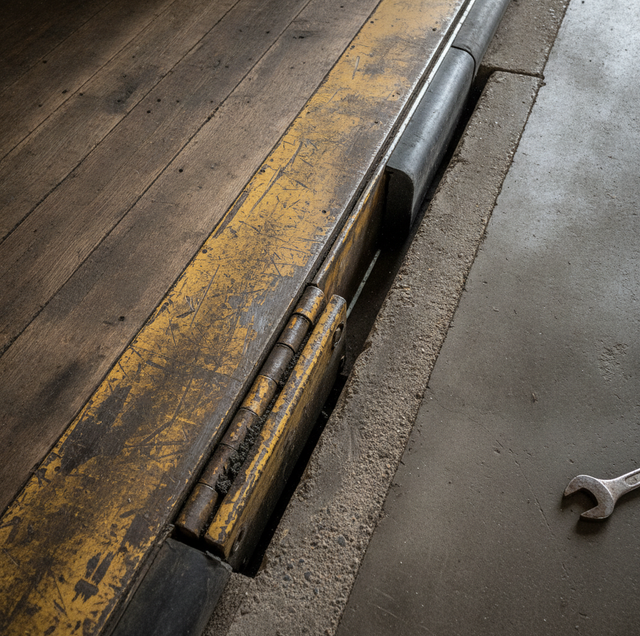
If you run a shipping and receiving operation, you have watched a forklift pause at the edge of an open dock door dozens of times a day. Between the concrete dock floor and the back of a parked trailer sits a stretch of open air and a difference in height. Something has to close that space before a loaded forklift can roll across it. That something is a dock leveler, and it is one of the hardest-working pieces of equipment on the entire dock.
Quick Answer: A dock leveler is the adjustable steel bridge built into a loading dock that spans the gap and the height difference between the dock floor and a trailer bed, so forklifts can drive on and off the trailer safely. Its deck raises, a hinged lip folds out and rests on the trailer, and the whole platform then follows the trailer up and down as it is loaded.
What a Dock Leveler Actually Is
A dock leveler is a hinged steel platform set into a recessed pit at the edge of a dock door, or mounted to the face of the dock in some designs. At rest, it sits flush with your warehouse floor. When a trailer backs into the dock seal, the leveler does two jobs at once: it covers the horizontal gap between the dock and the trailer, and it makes up the vertical difference between your floor height and the height of that particular trailer bed.
That second job is the reason a fixed ramp will not work. No two trailers sit at the same height. An empty box trailer rides higher than a loaded one. A refrigerated unit, a flatbed conversion, and a standard dry van all present different bed heights at the same dock. The leveler adjusts to each one, which is why it is an adjustable bridge rather than a static plate.
It works like a drawbridge that also raises and lowers its far landing to meet whatever is on the other side. The deck is the roadway, the lip is the far end that reaches out to touch the trailer, and the mechanism underneath sets the angle so the crossing stays smooth for the forklift.
How a Dock Leveler Works, Step by Step
The working cycle is short, but each stage matters. First, the operator activates the leveler, and the deck raises up above the level of the trailer bed. As the deck rises, a hinged section at the front called the lip swings out from its stored position. Once the lip is extended, the deck lowers, and the lip settles onto the trailer floor, overlapping the bed by several inches. That overlap is what carries the forklift wheels from the fixed deck onto the moving trailer without a lip that could catch a tire.
With the lip resting on the trailer, the leveler is in its working position, and the forklift can cross. Here is the part that separates a leveler from a plain ramp: as the forklift drives into the trailer, the trailer's suspension compresses and the bed drops. As the forklift backs out, the bed rises again. This up-and-down movement under load is called trailer float. A dock leveler is built so the deck and lip float with the trailer, following that motion so the ramp surface stays in contact with the bed. Without a trailer float, a rigid ramp would either lift off the bed and leave a gap or dig into it, and either one puts a forklift and its operator at risk.
When loading is finished, the operator returns the leveler to its stored, cross-traffic position where the deck sits level with the floor and the lip folds back, so the dock can be walked across and swept like any other stretch of floor.
The Three Types of Dock Levelers
Levelers are grouped by what raises the deck and extends the lip. The three common designs suit different traffic volumes and budgets for operator effort.
A mechanical leveler is spring-loaded. The operator pulls a release chain, stored spring tension raises the deck, and the operator then walks the deck down onto the trailer, which sets the lip. It is a proven design with fewer powered components, but it takes real physical effort every cycle, and the springs need periodic adjustment as they age.
A hydraulic leveler is powered. The operator presses a button, a hydraulic cylinder raises the deck and extends the lip, and the deck lowers onto the trailer under controlled power. There is no chain to pull and no walking the deck down, which cuts operator strain and speeds up each cycle. On a high-traffic dock that turns many trailers a day, that reduced effort and higher reliability usually earns the hydraulic design its place.
An air-powered leveler uses an inflatable airbag. A blower inflates the bag to raise the deck, and the lip extends as the deck rises. Like the hydraulic version, it is push-button and low-effort, with no hydraulic fluid to leak, which some facilities prefer for cleaner maintenance.
Key Parts of a Dock Leveler
Knowing the parts makes it far easier to describe a problem to a service technician and to understand a repair estimate.
The deck, or platform, is the main hinged steel surface that the forklift rolls across. The lip is the hinged extension at the front that reaches out and rests on the trailer bed. The rear hinge connects the deck to the pit and lets the whole assembly pivot. The lift mechanism is whatever raises the deck: coil springs on a mechanical unit, a hydraulic cylinder and power unit on a hydraulic one, or an airbag and blower on an air-powered one.
Then there are the safety devices, and these are the parts a facilities manager should know by name. Lip keepers are small catches that hold the lip in its stored position so it cannot swing loose during cross traffic. The maintenance strut, sometimes called a safety leg or working strut, is a prop that holds the raised deck open so a technician can work underneath it. A velocity fuse or free-fall stop is a device that catches the deck if it starts to drop too fast, which happens when a trailer pulls away before the operator has retracted the leveler. That fuse is what keeps the platform from slamming down into the pit.
Why the Dock Leveler Matters to Your Operation
Everything about a dock leveler comes back to closing two distances safely: the vertical height difference and the horizontal gap. Close both correctly, and a forklift crosses onto the trailer as if the floor simply continued. Close either one poorly, and you have a trip point, a wheel catch, or a drop that can tip a forklift or pin an operator.
Beyond safety, the leveler is what protects your loads and your throughput. A smooth transition means product is not jolted at the threshold, pallets stay stable, and the loading pace stays steady. When a leveler fails, that dock door stops working, and a stopped door in a busy warehouse means trucks waiting, appointments slipping, and labor standing idle. Uptime on the leveler is uptime on the dock.
Understanding Capacity Ratings
Every leveler carries a load rating, and reading it correctly protects both people and equipment. The rating has to cover the forklift plus its heaviest load combined, not just the freight. A common oversight is rating a leveler for the pallet weight while forgetting that the forklift itself may weigh as much as or more than what it carries.
There is also a difference between a static number and a working, moving-load number. A forklift crossing the deck applies force that shifts and impacts as the wheels roll and brake, so the under-load capacity, the rating for a moving forklift, is the figure to match against your equipment. When you spec or replace a leveler, size it to the loaded weight of your heaviest forklift, with a margin, rather than to an average pallet.
When a Dock Leveler Needs Service or Replacement
A leveler rarely fails all at once. It tells you first, and catching the early signs keeps a small repair from turning into a downtime event or a safety incident.
Watch for a lip that will not fully extend or will not hold its position on the trailer, since that removes the safe overlap the crossing depends on. A deck that sags, drifts, or will not stay level points to worn springs or a hydraulic problem. On powered units, slow operation or visible fluid under the pit signals a hydraulic leak. On mechanical units, springs that make the deck hard to raise or that no longer hold tension are worn and due for adjustment or replacement. Any fault in a safety device, a lip keeper that will not catch, a maintenance strut that will not lock, or a velocity fuse that is not functioning takes the unit out of safe service until it is fixed.
One rule sits above all the others: never work under a raised leveler unless the maintenance strut is engaged and locked. A deck that drops with a person beneath it is a serious hazard, and the strut exists for exactly that reason. Dock leveler service is a job for a trained commercial technician with the right parts and lockout procedure, not a task to improvise during a shift.
Frequently Asked Questions
It bridges both the horizontal gap and the vertical height difference between the dock floor and the trailer bed. The hinged lip is sized to overlap the trailer bed by a generous margin, commonly four inches or more, so a forklift's wheels roll across a continuous surface and never meet an exposed edge at the seam. Once that overlap is set, the platform tracks the bed as it rises and settles under the load.
A mechanical leveler is the lower-cost option, but it needs manual pull-chain operation every single cycle. A hydraulic leveler adds push-button controls, and because it is powered, it can be wired into a light and interlock system that ties the leveler to the vehicle restraint and dock door, sequencing them so the deck cannot deploy until the trailer is secured. That integration and the reduced strain are why it tends to win on a dock, cycling many trailers a day.
A loaded trailer can rise and drop several inches on its suspension as a forklift moves in and out, and the leveler's float range has to cover that whole travel. When it does not, the crossing develops what techs call lip creep, where the lip walks back off the bed and opens a gap a wheel can drop into. Float is what keeps the lip planted on the bed through that several-inch movement instead of losing contact.
The velocity fuse and maintenance strut protect the deck itself, but the bigger hazard is the trailer rolling away mid-load. OSHA-guided practice and many jurisdictions pair the leveler with a separate restraint for that: wheel chocks under the trailer tires, or a powered trailer restraint that hooks the trailer's rear impact guard or drops a barrier so the truck physically cannot pull off the dock until it is released.
It is the working load the leveler can handle, and it has to cover the forklift plus its heaviest load combined, not the freight alone. Pit levelers come in a handful of standard working-load ratings, commonly around 25,000, 30,000, or 40,000 pounds, and you pick the tier by the loaded weight of your heaviest forklift. Because a moving forklift shifts and impacts as it rolls and brakes, size to that under-load figure rather than a static one.
Watch for a lip that will not extend or hold, a deck that sags or drifts off level, slow or leaking hydraulics, or worn springs that make the deck hard to raise. What service looks like depends on the style: a pit leveler is the recessed type serviced in place from within its pit, an edge-of-dock (EOD) unit mounts on the face of the dock and is smaller and easier to reach, and a vertical-storing unit parks upright inside the door. Any of those faults should bring a technician before it becomes a downtime or safety problem.
Schedule a dock leveler inspection with our commercial team — keep your docks loading without unplanned downtime. Prime Dock & Door LLC serves La Mirada, Anaheim, and Santa Ana. Call (714) 683-2201.
