

What Causes Hydraulic Leaks in a Dock Leveler? Four Places to Look
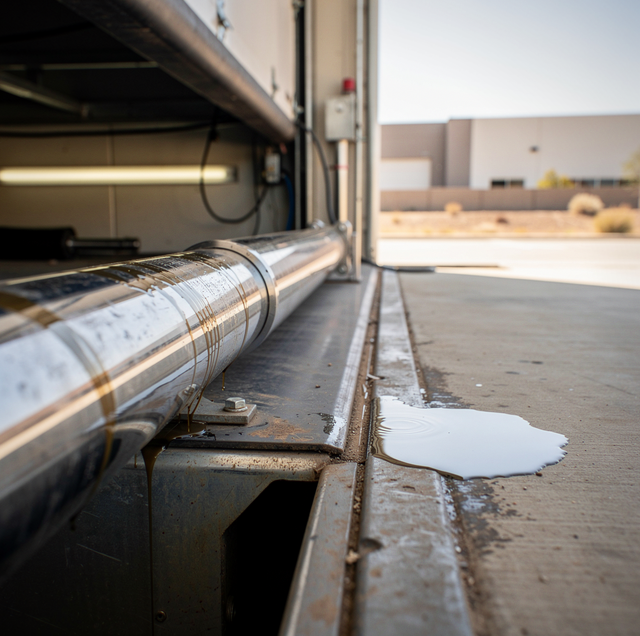
The deck comes up fine every morning. By the third or fourth truck of the day, it sits an inch lower than where the operator left it, and nobody saw it happen. A hydraulic dock leveler doesn't lose fluid all at once from one mysterious source; it loses fluid from one specific point in the circuit, and where that point sits changes what the fluid is doing, what it looks like on the floor, and how urgent the repair is.
The Cylinder Rod Seal: The Slow Drift You Notice in the Morning
The lift cylinder is a barrel with a piston and a chrome-plated rod that extends and retracts as the deck rises and falls. A wiper seal at the top of the gland keeps grit off the rod on the way back in; a rod seal beneath it is the one that actually holds pressure against the rod. When that rod seal starts to lose its grip, from age, a scored rod surface, or grit that got past a worn wiper, fluid weeps along the rod on every stroke. Early on, it's a thin film on the chrome, visible with the rod partly extended. Left alone, that film becomes a run, then a drip.
The reason this leak shows up as drift rather than spray comes down to what's supporting the deck. A raised deck maintains its height through a closed circuit: a check valve locks fluid in the cylinder once the pump shuts off, and the rod doesn't move while the deck rests. A rod seal losing its grip lets a small amount of the locked fluid bypass with every micro-shift in load, so the height settles by fractions of an inch rather than dropping. That's the leveler that's fine at 7 a.m. and needs re-leveling by lunch, with fluid on the chrome as the only visible clue. None of this applies to a mechanical or air-powered leveler, which has no hydraulic circuit to lose fluid from and a deck that won't move at all, pointing to a different failure than the one covered here.
Hose and Fitting Leaks: Spray Under Pressure or Seep at Rest
Past the cylinder, the rest of the circuit runs through hose and a handful of fittings connecting the pump, valve block, and cylinder ports. Two different failures live in that stretch of plumbing, and they announce themselves in opposite ways.
A pinhole in the hose wall, usually from years of flexing at a crimp or rubbing a frame edge on every cycle, needs real pressure behind it to show. That pressure peaks while the pump is actively pushing fluid: raising or lowering the deck. Stand near the power unit during a cycle, and a hose pinhole sprays a fine mist or a thin jet, sometimes audible before it's visible. The instant the deck reaches position and the check valve takes over holding it, pressure drops to a lower static value, and the same hole slows to a drip nobody notices.
A leaking fitting, a JIC flare connection, an O-ring boss port, or a crimped hose end usually does the opposite. A slightly under-torqued fitting or a compression-set O-ring seeps too slowly to notice mid-shift. Overnight or over a weekend, the fluid and the fittings cool and contract, and nothing is running to move the film along, so what shows up on Monday is hours of quiet accumulation rather than a leak that started while the dock sat still. A corroded fitting fails by a different path than a compressed O-ring, though the two can show up at the same joint. Chasing a "sprays when running" leak in the wrong spot, or writing off a "wet only when parked" fitting because the deck worked fine all day, is chasing the wrong half of the circuit.
The Velocity Fuse: Why an Untripped Leak Is a Different Problem
Hydraulic dock levelers built in the last couple of decades typically carry a velocity fuse threaded into a cylinder port, built for exactly one failure: a hose or fitting letting go completely. If a pressure line ruptures outright, fluid rushes out of the cylinder, and that sudden spike in flow rate is what the fuse senses. It closes, traps the fluid still in the cylinder, and stops the deck from free-falling under the weight sitting on it.
A slow weep from a rod seal or a hairline pinhole doesn't come close to the flow rate a velocity fuse watches for. The fuse stays open, fluid keeps leaving a few drops at a time, and nothing about the leveler's behavior signals an emergency. That's the real split between the two classes of hydraulic problem here: a full hose failure is loud, fast, and caught by a device built for exactly that event, while a slow leak is quiet and depends entirely on someone noticing fluid on the floor, because the one safety mechanism watching this circuit was never built to catch it.
The Pump and Reservoir: Low Fluid Is a Symptom, Not the Cause
When a leveler is losing lift power or takes longer to reach height, the reservoir is the first thing most people check, and it usually is low. That's true, and it's also where diagnosis stops too early. The reservoir doesn't leak on its own the way a rod seal or a hose fitting does; a low tank means fluid is left somewhere else in the circuit, and the reservoir is just reporting the loss.
Read the reservoir with the deck fully lowered and the rod retracted. A level checked with the deck up reads low because that fluid is still in the cylinder, and topping off then overfills the tank once the deck comes back down.
Topping it off is the natural response, and it's also how a manageable leak turns into a failure nobody saw coming. Refilling makes the leveler work normally for a while, which appears fixed to anyone not tracking how often it happens, while the leak keeps draining the same amount it always did. Eventually the interval between top-offs shortens, someone misses one, and the pump's inlet draws air instead of fluid. A pump running on air cavitates: it aerates the fluid it has, runs hot, and can score its own internals in a single bad cycle.
One Cold Snap, a Dozen Levelers: Viscosity and Seal Shrinkage
A circuit that has sealed fine for years can start weeping the same week the temperature drops, and the unit that shows it first is worth treating as a reason to look at the others. Two things happen when it gets cold: the fluid thickens, and the seals slightly shrink.
Hydraulic oil is rated to a viscosity grade for a working temperature range, and outside that range it behaves differently. Cold fluid resists flow, increasing the effort the pump must overcome, and can starve a marginal seal of the lubrication film it needs to seal properly. At the same time, the rubber and polyurethane compounds in rod seals and O-rings contract slightly as they cool. A seal with just enough interference fit against the rod or fitting bore in warm weather can lose the last fraction of that fit in the cold, and a path opens that wasn't there the week before. Levelers installed together run seals of the same age, so when cold pushes one past its interference fit, the others on that lot are not far behind it.
Heat pulls the opposite direction toward the same result: thinner, hotter fluid moves through the smallest gap far more easily than cold fluid does, so a seal barely holding in mild weather can start showing a leak on the first real heat wave too. Cold shrinks the seal; heat thins the fluid. Either one finds the same weak point.
What the Leak Does to the Dock: Drift, the Lip, and the Restraint Interlock
A hydraulic leak changes how the leveler behaves under an actual truck. Deck drift, the most common symptom, is often just an inconvenience that means re-leveling more than once a shift.
The lip is the more consequential failure. A dock leveler uses the same circuit, or a linked one, to extend the lip onto the trailer bed once the deck reaches height, and that extension depends on sufficient pressure and volume being available when it's called for. A circuit that's lost fluid can extend the lip slower than normal, only partway, or not at all, leaving a gap between the dock edge and the trailer bed instead of a supported transition. That gap is where a pallet jack wheel drops, not where fluid pools.
Many facilities also run a truck restraint interlock that sequences the leveler and restraint together, so the deck isn't supposed to operate, or the truck isn't supposed to be released, until the restraint has engaged properly. A leveler losing hydraulic pressure can behave unpredictably at exactly the moment that sequence matters, settling or hesitating in ways the interlock was never built to interpret.
A raised deck is held by hydraulic pressure, not by anything mechanical. The maintenance strut must be deliberately engaged before anyone goes underneath. A leaking circuit can settle at any time; no leak state makes an unpropped deck safe to stand under.
Which of these is worth fixing depends on what's actually failing, not just where fluid is showing up. A weeping rod seal or a leaking fitting is usually a seal kit and a few hours of labor, the most common and least expensive repair of everything above. A rod seal that keeps failing on the same cylinder points to a different problem underneath it: a scored rod or a cylinder bore that's lost its finish, where a new seal holds for a few weeks and then weeps again; the fix there is the cylinder, not another kit. When leaks show up in more than one place at once, on a leveler already carrying corrosion, worn bearings, or a deck flexing where it shouldn't, that stops being a repair conversation. It becomes a question of whether the unit has reached the end of what's worth putting into it, a call that sits apart from any single leak.
Frequently Asked Questions
Yes. The lip cylinder and the return lines running back to the reservoir sit outside the part of the circuit that holds deck height, so fluid can leave from either one while the deck still parks exactly where the operator left it. The tank drops, the deck doesn't, and the only evidence is what collects underneath.
The usual fill is a general-purpose anti-wear hydraulic oil in a common industrial viscosity grade, not a specialty fluid, though the exact grade should come from the leveler's own manufacturer documentation rather than whatever is on the shelf. Using the wrong grade doesn't just affect performance; a fluid too thin for the unit's seals can shorten seal life on its own, independent of any existing leak.
Every lift-and-lower cycle flexes the hoses and puts the seals through a load-and-release cycle, so a dock running dozens of cycles a day reaches the same wear threshold in a fraction of the calendar time it takes a low-traffic dock to reach it. Cycle count, not just calendar age, is often the better predictor of when the first leak shows up.
The fluid itself is usually a housekeeping and slip hazard, but the pressure loss behind it is the real concern: it lets a deck drift or a lip fail to seat fully, changing the footing at the edge of the pit. Whether a given leak triggers a reporting or containment requirement is a question for the facility's own safety authority, since that depends on the fluid and the jurisdiction, not on the leveler itself.
A pump that's pulled air instead of oil typically announces itself with a sharp, higher-pitched whine or a new knocking sound during the lift stroke, along with a reservoir that feels noticeably warmer than usual after just one cycle. Either sign showing up after a top-off is worth treating as pump damage already done, not just a leak still in progress.
No. Some older units and a few lower-cost designs either skip the fuse entirely or fit one on a single port rather than both, leaving the unprotected side of the circuit without anything monitoring it for a rupture. The leveler's data plate or the manufacturer's parts documentation is the way to confirm what's actually installed, and that check is worth making before anyone assumes a hose failure would be caught.
Get a hydraulic leak on your dock leveler diagnosed and repaired — before a slow leak becomes a stalled dock. Prime Dock & Door LLC serves La Mirada, Anaheim, and Santa Ana. Call (714) 683-2201.
