

Commercial Dock & Door Inspection Schedule: What Cycles Demand
Quick Answer: Most commercial docks and doors need a daily visual check by operators, a professional preventive-maintenance visit every three to six months for typical use, and monthly professional attention at very high-cycle sites. The interval scales with how many times the door opens and the leveler is stored each day.
A loading dock is one of the busiest square feet in any facility, and the equipment that runs it rarely gets a second thought until it stops working. The question of how often docks and doors should be inspected does not have a single calendar answer, because the right interval is set by how hard the equipment is worked, not by the passing of months.
Why Scheduled Inspection Beats Waiting for a Breakdown
Commercial overhead doors and dock levelers are high-cycle equipment. A busy sectional door can run several hundred open-close cycles in a single shift, and a hydraulic leveler is worked every time a trailer backs in and pulls out. Residential garage doors might see a few cycles a day; a commercial door can see that many before the first coffee break. Wear that would take years to appear on a home door shows up in months on a dock.
That accumulation matters because a failure at the dock is never just an inconvenience. When a door jams closed, or a leveler will not raise, trucks queue in the yard, product sits, and the shipping schedule slides. Scheduled inspection is the difference between replacing a worn roller on your terms and clearing a wrecked door on the carrier's.
When a torsion spring lets go, or a leveler drops under load, the failure becomes a safety hazard for the forklift operator crossing the gap and the workers standing near the opening. Any work involving lockout/tagout, spring tension, or hydraulic components is reserved for trained, qualified personnel.
A dock earns its keep the way a fleet manager treats a delivery truck: the truck gets serviced on a mileage schedule, not when it dies on the highway, because the cost of the roadside failure dwarfs the cost of the oil change.
Cycle count is the dock's mileage, so a door counter or a simple log of daily truck volume tells you far more about when service is due than the date on the calendar does.
How Cycle Volume Sets the Interval
Two facilities can own identical equipment and need completely different service schedules. A parts warehouse that ships twice a week is a light-duty site. A regional cross-dock running trailers in and out around the clock is severe-duty, and its doors and levelers age several times faster.
Reading Your Own Duty Level: A rough way to place a site: count the average daily openings on the busiest door and the number of trailers handled per leveler per shift. Low daily volume points to the longer end of the professional interval. Constant traffic, multiple shifts, or doors that also serve as security barriers push toward the short end. Add stress from heavy dust, wash-down areas, or hardware exposed to salt-laden or corrosive air, and shorten the interval further, because corrosion attacks cables, springs, and roller bearings faster than clean indoor service does.
A Practical Inspection Cadence
Use these as a starting framework, then adjust to your measured cycle volume.
Daily Operator Checks: Trained operators should run a quick visual and functional check at the start of each shift. This is looking and listening, not adjusting: does the door track smoothly and quietly, does it reverse when it should, does the leveler store flat, are there new grinding or scraping sounds, is anything visibly frayed, bent, or leaking. Staff performs visual checks only. Any adjustment or repair is professional work.
Quarterly to Semiannual Professional Preventive Maintenance: For typical commercial use, a qualified technician should perform a full preventive-maintenance visit every three to six months. This is the hands-on inspection where components are tested under load, hardware is tightened, moving parts are lubricated, and worn items are caught before they fail.
Monthly Professional Attention for Very High-Cycle Sites: Sites running continuous shifts, very high door counts, or heavy trailer throughput should move to a monthly professional cadence. At that volume, quarterly service leaves too long a window for a high-tension component to reach the end of its life between visits.
What a Thorough Inspection Actually Covers
A real inspection walks the whole system, door and dock, because the two work as one flow.
On the door side, a technician checks the springs and cables for wear, corrosion, and correct tension; commercial springs and cables hold high tension, so this is professional-only work. Rollers and tracks are examined for flat spots, seized bearings, and alignment, since a binding track drags on every cycle. The opener or operator is checked for motor strain, drive wear, and correct limit settings. Photo-eyes and the reversing system are tested to confirm the door stops and reverses on an obstruction, the single most important safety function on a powered door. Weatherseals around the door perimeter are inspected for gaps that let in dust, pests, and outside air.
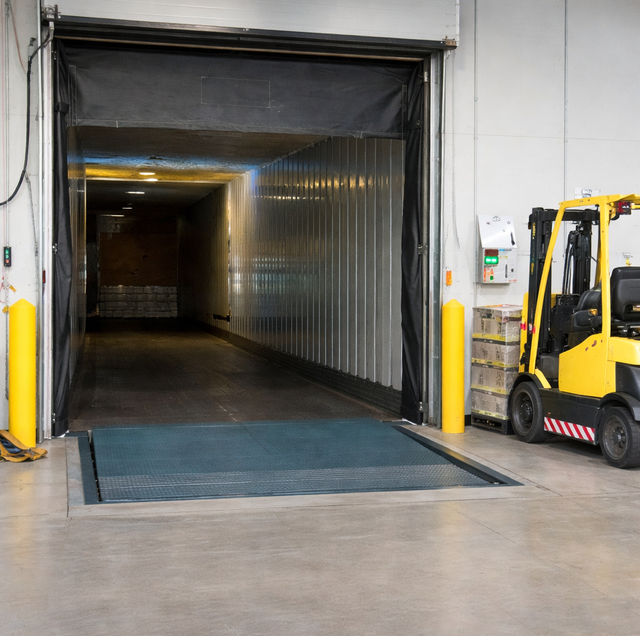
On the dock side, the dock leveler and lip are cycled and checked for smooth operation, worn hinges, and a lip that extends and seats correctly, with the hydraulics or mechanical springs examined for leaks and fatigue. Dock seals and shelters are checked for compression set and torn fabric that breaks the trailer seal. Bumpers are measured for wear, because a bumper worn past its useful thickness lets a trailer strike the dock face and the building. The truck restraint or wheel-based hold system is tested to confirm it engages and holds a trailer against pull-out.
Downtime Cost Versus Preventive Maintenance
The economics favor prevention by a wide margin. A preventive visit is a scheduled, predictable event that happens between trucks. An emergency failure is the opposite: it happens at the worst moment, it stops inbound and outbound freight at once, and it often costs more in idle labor, detained trailers, and expedited parts than the repair itself. A door that fails mid-cycle can also damage adjacent components on the way down, turning a single worn part into a multi-part replacement. Planned maintenance converts an unpredictable large cost into a small predictable one and keeps the dock earning instead of blocking.
Safety Testing Is Not Optional
Beyond keeping equipment running, inspection is a safety obligation. Powered doors and heavy dock equipment operate around people and forklifts, and the systems that protect them- the reversing sensors, the restraint, the leveler's fall protection- degrade silently. A photo-eye knocked slightly out of alignment or a restraint that no longer latches gives no warning until someone needs it. Regular functional testing verifies these protections still work before an incident proves they do not. General workplace safety practice expects powered material-handling equipment to be maintained and tested on a routine basis, and dock inspection is how that expectation is met on the floor. Any work involving lockout/tagout, spring tension, or hydraulic components is reserved for trained, qualified personnel.
Signs an Inspection Is Overdue
Do not wait for the calendar if the equipment is already talking to you. Book a professional visit when you notice any of these:
- New grinding, squealing, or banging on a door that used to run quietly
- A door that hesitates, stutters, or opens and closes unevenly
- A dock leveler that drifts, sags under load, or will not store flat
- Visible fraying on a cable or a gap in the coils of a spring
- A door that does not reverse cleanly when the photo-eyes are blocked
- Bumpers worn thin, cracked, or torn loose from the dock face
- A truck restraint that no longer latches or signals reliably
- Trailer seals showing daylight, torn fabric, or crushed foam
Any one of these means the wear is already past the point where a routine visit would have caught it, and the next stage is failure.
Frequently Asked Questions
Yes. High-speed roll-up doors used for climate or dust separation cycle far more often than a standard sectional dock door and typically move up one service tier, while an insulated sectional door with a chain hoist that opens only a few times a day can sit at the lighter end. A rolling steel security door also needs its slats and guides checked for grit buildup, which a sectional door does not have.
For a single dock position with one door and one leveler, a technician usually needs roughly one to two hours to cycle-test, tighten, lubricate, and document findings. A multi-position dock is scheduled in a rotation so a few positions are serviced per visit, keeping the rest of the dock live and trucks moving during the work.
Your team should own the daily visual checks and note anything unusual, but torsion-spring tension, cable replacement, and leveler hydraulics carry stored energy that can injure an untrained person severely. Those tasks, plus load-testing the restraint and reversing system to a repeatable standard, need a qualified commercial technician with the correct tools and lockout procedure.
Keep a dated log per dock position listing what was tested, parts replaced, spring-cycle life remaining if measured, and any deferred items flagged for the next visit. This history reveals which positions wear fastest, justifies budget for replacements before they become emergencies, and gives an inspector or insurer a clear maintenance trail.
The dock bumper is the most commonly neglected wear item, because it looks solid long after it has lost its cushioning. Once a bumper compresses below its rated thickness, trailer impacts transfer straight into the dock leveler frame and the building wall, so a worn bumper quietly damages far more expensive components before anyone replaces it.
Yes. A trailer that backs in too hard or pulls away before the lip retracts can bend a leveler lip, crack a bumper mount, or knock a door track out of alignment even when nothing looks broken. An off-cycle inspection after a known impact catches hidden frame or track damage before the next load rides on a compromised part.
Book a preventive dock and door inspection before a failure stops your trucks — protect uptime and worker safety with a schedule matched to your cycle volume. Prime Dock & Door LLC serves La Mirada, Anaheim, and Santa Ana. Call (714) 683-2201.
