

Commercial Door Off Track: 6 Causes to Rule Out
| What You See | Likely Cause | What To Do |
|---|---|---|
| Door hangs crooked, one side higher | Broken or unwinding torsion spring | Stop using the door; call a technician; do not touch the spring |
| Loud bang, then door won't move | Snapped spring or cable | Stop using the door; treat as a professional-only repair |
| Door wobbles or shakes while moving | Worn or flat-spotted rollers | Schedule roller inspection and replacement |
| Door binds partway, won't fully close | Track out of plumb or bent | Have track alignment checked before forcing the door |
| Panel edge visibly separated from track | Bent track from impact | Stop operation; track needs straightening or replacement |
| Door reverses or stops on its own | Sensor or limit switch fault, not a track issue | Check photo eyes and limit settings before assuming track damage |
A bent bracket and a snapped spring can produce the same symptom: a door hanging crooked and refusing to close, and chasing the wrong one wastes a service call while the real problem keeps getting worse. The table above sorts the six most common causes by what a facility team actually sees on the shop floor, but matching a symptom to its mechanism is only half the job. Knowing which of those six is safe to handle in-house and which is strictly a professional repair is what keeps a minor fix from turning into an injury or a much bigger bill.
Impact Damage To The Track
Tracks run vertically along both sides of a commercial door opening and take the brunt of any contact from forklifts, pallet jacks, or trucks backing in too fast. A single hard hit can bend the track inward just enough that rollers no longer sit flush in the channel. Once that happens, every cycle after the impact drags a roller against a pinch point in the bent section, and the door either binds there or, if the bend is severe enough, jumps the roller completely off the rail on the next pass. Track damage from impact is almost always localized to one spot, which is why a door that ran fine for years can suddenly start acting up at the same point in its travel every single cycle.
Loose Or Worn Track Hardware
Track brackets bolt to the wall or building structure at intervals along the full run, and those bolts work loose over years of vibration from a door cycling dozens of times a day. A bracket that's loosened even a small amount lets the track flex sideways under load, and a track that flexes doesn't hold a roller in line the way a rigid, properly fastened track does. This kind of failure tends to be gradual: a door that used to run quietly starts rattling at one bracket, then binds, and eventually lets a roller slip free if the loose hardware isn't caught and retightened first.
Roller Wear And Failure
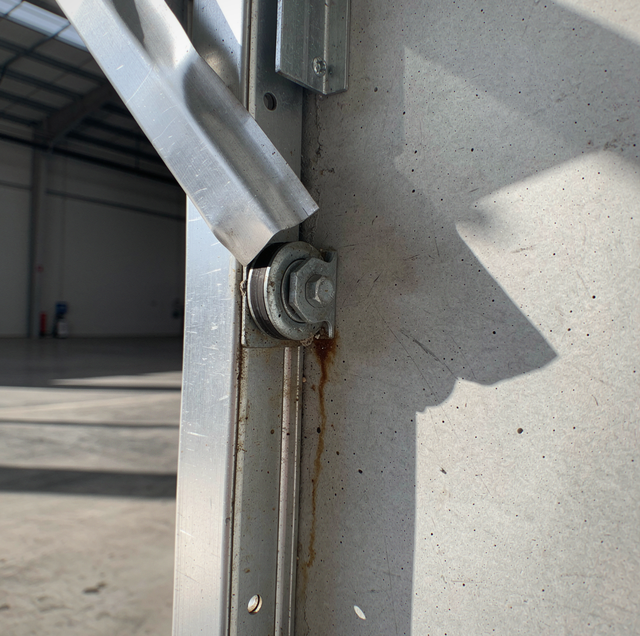
Rollers are the wheels that ride on the track, and they carry a continuous frictional load every time the door cycles. Standard steel rollers wear down over time and can develop flat spots or seized bearings; nylon rollers, common on higher-cycle commercial installs because they run quieter, wear differently but still degrade with age and exposure to dust or grit in the track. A roller that's worn undersized no longer fills the track channel the way it should, which gives it just enough slack to walk out of the rail under the wrong combination of speed and vibration.
Misaligned Or Out-Of-Plumb Tracks
Buildings settle, and over years that settling can pull a track out of plumb even without any direct impact. When the two tracks aren't parallel, or one side has drifted slightly out of vertical, the door has to twist very slightly with each cycle to travel the full distance. That twisting stresses the rollers unevenly; one side wears faster than the other, and the door develops a rocking motion that eventually causes a roller to walk past the edge of the track. This is one of the harder issues to catch just by looking, since the misalignment can be a fraction of an inch at the top of the track and still cause real problems.
Spring And Cable Imbalance
Commercial doors of real size and weight use a torsion spring system to counterbalance the door so the opener isn't lifting the full weight on every cycle. If one spring loses tension relative to the other, or a cable comes off its drum on one side, the door lifts unevenly, faster on one side than the other. That imbalance shows up first as a door that looks crooked mid-travel, and if it goes uncorrected, the uneven lift puts lateral stress on the rollers and track that can eventually pull a roller loose. Spring and cable systems store enough energy under tension to cause serious injury if handled incorrectly, so any suspected spring or cable issue is strictly a professional repair, never a shop-floor fix.
Debris And Obstruction In The Track
Tracks accumulate more than most facility managers expect: packing debris, dropped hardware, and buildup from dust and grit that get ground into a paste by rollers passing over them repeatedly. An obstruction doesn't have to be large to cause a problem; something as small as a stray bolt wedged in the channel can force a roller sideways just enough to pop it free on the next cycle. This cause is also two-sided by climate: dust and debris build up the same way in a dry inland facility as they do anywhere else, while a dock with more outdoor exposure sees a faster buildup of grit tracked in from vehicle traffic and needs the track cleaned out more often to stay ahead of it.
When It's A Professional-Only Repair
Any repair involving a torsion spring, a lift cable, or the counterbalance system stores enough energy to cause serious injury, and that work should never be attempted by facility staff, regardless of how confident anyone feels about it. Track straightening also requires the right tools and an understanding of how much force a given track gauge can withstand before it's damaged further rather than corrected. The parts of this list that are reasonable for a facility team to handle are visual inspection, keeping tracks clear of debris, and flagging early signs: a new sound, a slight wobble, a door that looks crooked, before they progress into a jumped track.
Frequently Asked Questions
Most technicians consider any visible deviation greater than about a quarter inch from straight along a track section sufficient to warrant taking the door out of service, since a bend that size already forces rollers to ride against the flange rather than be centered in the channel.
Don't treat this as a facility work-around. A compromised spring or cable can cause a heavy door to drop without warning during manual operation, and there's no reliable way for a maintenance team to confirm the spring's condition just by looking; a spring can appear fine and still be moments away from failing. Disconnecting the opener doesn't make hand-cranking safe on its own; any door that's come off its track should remain out of service, whether the opener is connected or not, until a technician has inspected the spring and cable system.
Galvanized track resists surface corrosion better over the door's service life, and a corroded track surface can create just enough extra friction and pitting to accelerate roller wear compared with a track that's stayed smooth.
Yes, if the underlying bracket or track section wasn't replaced, since the geometry that allowed the roller to escape the first time is usually still there; a repair that just reseats the roller without addressing the bent section or loose bracket tends to repeat within months.
A door cycling more than a few dozen times a day benefits from a hardware check, brackets, rollers, and track alignment roughly every three months, whereas a lower-traffic door often needs this only twice a year to catch developing issues.
Steel track expands and contracts slightly with temperature swings, and a bracket that's marginal to begin with can loosen faster from that repeated thermal movement, which is one more reason loose hardware tends to show up first at the same handful of bracket points on a given door.
Every cause on this list traces back to one of three things: impact, hardware that's loosened or worn, or a spring and cable system that's lost its balance. A facility team that can name which of those three is happening, instead of just reporting "the door's off the track," gives a technician a real head start, and keeps the visual inspection and debris-clearing work where it belongs, with the people who see the door every day, while the spring, cable, and track-straightening work stays with the people trained to handle it safely.
Get your commercial door back on track — Same-day diagnosis and repair for tracks, rollers, and springs so your bay isn't down longer than it has to be. Prime Dock & Door LLC serves La Mirada, Anaheim, and Santa Ana. Call (714) 683-2201.
