

What Actually Corrodes Dock and Door Hardware Fast
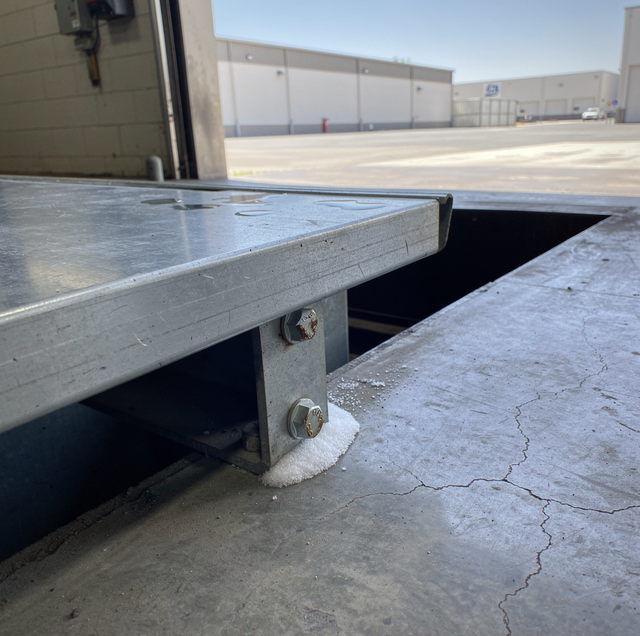
Why do two facilities running the same brand of dock leveler, installed the same year, end up with completely different hardware conditions a few years later? The honest answer has less to do with how hard the equipment is used and more to do with what's touching the metal every single day. Corrosion is a chemical process, not just wear from time passing, and understanding what drives it changes how a facility protects hardware instead of just replacing it on a fixed schedule.
The Chemistry Behind Rust, In Plain Terms
Corrosion on steel hardware is an electrochemical reaction: iron in the steel reacts with oxygen in the presence of moisture, producing iron oxide (rust). That reaction needs three things to run fast: oxygen (always present), moisture (from humidity, condensation, or standing water), and an electrolyte, something dissolved in that moisture that speeds the electron transfer along. Plain rainwater corrodes steel slowly. Water carrying dissolved salts, whether that's airborne sea salt, road de-icing salt tracked in on truck tires, or mineral content from certain industrial processes, corrodes it much faster because the dissolved salt acts as an electrolyte that accelerates the reaction.
Airborne Salts, Chemicals, And Humidity As Accelerants
Several environmental conditions push that reaction into overdrive, and most facilities deal with more than one at once. Airborne salt from ocean proximity is one well-known accelerant, carried on wind and settling as a fine film on any exposed metal, including dock levelers, hinges, and door tracks near loading areas. It's not the only one. Facilities in colder climates see the same acceleration from de-icing salt and brine tracked onto truck tires and forklift wheels during the winter months, which then sit in standing puddles near the dock pit long after the trucks have moved on. Manufacturing and food processing facilities introduce their own accelerants: chlorine-based cleaning chemicals, ammonia from refrigeration systems, or acidic byproducts from certain production processes, all of which can be just as aggressive on exposed hardware as salt air. None of these conditions is worse than the others in the abstract; what matters is which ones are actually present at a given facility, since a dock exposed to two or three of them at once corrodes noticeably faster than one exposed to just humidity.
Galvanic Corrosion Between Dissimilar Metals
A second mechanism, separate from plain rust, happens when two different metals are in direct contact in the presence of moisture: galvanic corrosion. One metal acts as the anode and corrodes preferentially while the other, the cathode, is protected. This shows up in dock and door hardware more often than facility managers expect, such as a stainless steel bolt threaded into a plain steel bracket, or an aluminum component fastened directly to a steel frame without an isolating barrier. The less noble metal in that pairing corrodes faster than it would on its own, sometimes dramatically faster, which is why a hardware failure can look confusing if the only thing checked is the age of the part rather than what it's touching.
Which Components Corrode First
Not every part on a dock or door assembly corrodes at the same rate, and knowing the order helps a facility catch problems before they become failures. Springs under constant tension are especially vulnerable to a specific failure mode called stress corrosion cracking, in which corrosion pitting combines with the metal's internal stresses to form cracks that can lead to sudden failure rather than a slow, visible weakening. Fasteners, bolts, and screws holding brackets and track sections corrode at exposed threads first since the coating on a fastener is thinnest right where the threads were cut. The bottom bar of a rolling steel door and the lip of a dock leveler both sit closest to floor-level moisture and salt residue and tend to show surface corrosion well before components mounted higher up the assembly.
How Fast The Damage Actually Progresses
Corrosion doesn't progress at a constant rate; it accelerates once it starts because rust is porous and holds moisture against the underlying metal better than a clean surface does. A small surface spot that would take years to become a problem on its own can progress much faster once pitting breaks through a protective coating, because the pit traps moisture and salt in a way flat, coated metal never allows. This is part of why hardware that looked fine at last year's inspection can show a meaningfully worse spot a year later even without any change in how the equipment is used; the corrosion that was invisible under an intact coating became visible the moment that coating failed at one point, and from there it spreads outward faster than it started.
Signs Corrosion Is Already Undermining Hardware Strength
Surface rust is cosmetic until it isn't, and the transition point is worth knowing rather than guessing at. Flaking or scaling rust, where the corrosion product lifts away from the surface in layers rather than staying as a thin film, usually means enough base metal has already converted to oxide that the part has lost real cross-section, not just surface finish. A spring or cable showing pitting along its length is a different concern than a bracket with surface rust, since pitting concentrates stress at each pit and is the specific precursor to stress corrosion cracking mentioned earlier. Any hardware showing rust-through, a hole, or a thin spot you can see light through has already failed structurally at that point, even if the rest of the part still looks intact, and should be treated as a replacement item rather than a candidate for a cosmetic cleanup and repaint.
Coatings And Materials That Resist It
The primary defense against all of this is the coating on the steel, not the steel itself, since bare steel corrodes readily regardless of thickness or grade. Hot-dip galvanizing bonds a zinc layer to the steel, which corrodes preferentially, protecting the underlying steel even when the coating is scratched, a property called sacrificial protection. Powder coating provides a different kind of protection: a physical barrier rather than a sacrificial layer. That means a scratch or chip in the powder coat exposes bare steel directly to moisture, with no backup protection at that spot. Stainless steel fasteners resist corrosion inherently through a passive chromium oxide layer that reforms on the surface if scratched, which is why swapping standard fasteners for stainless at known problem points is a common upgrade on hardware exposed to heavy salt or chemical contact, so long as the galvanic pairing with the surrounding metal is accounted for.
Maintenance That Actually Slows It Down
A few practices make a measurable difference on hardware exposed to any of these accelerants. Rinsing salt residue and chemical film off exposed metal on a regular schedule removes the electrolyte before it has time to sit and react, which matters more in a facility with heavy salt or de-icing exposure than in a dry, low-traffic bay. Keeping lubrication current on springs, hinges, and rollers does double duty: it reduces mechanical wear and also displaces surface moisture that would otherwise sit against bare metal. Touching up coating damage- a chip in powder coat or a scratch through galvanizing- promptly rather than waiting for a scheduled maintenance visit stops a small exposed spot from becoming a much larger corroded area, since corrosion spreads outward from any break in the protective layer once it starts.
Frequently Asked Questions
Yes, for salt specifically, but it's not a universal fix. Fresh water rinsing physically removes dissolved salt before it can concentrate as the water evaporates, which is one of the more underused maintenance steps. It does nothing for galvanic corrosion between dissimilar metals or for chemical residue from cleaning agents and refrigeration byproducts, both of which need to be addressed separately, isolating the metals in one case, using a compatible cleaning product in the other, since rinsing alone won't stop either of those reactions.
Zinc and stainless steel form a galvanic pair too, with the zinc coating acting as the sacrificial anode, so the zinc will wear away faster at that contact point over time; it's a manageable trade-off but worth knowing rather than assuming stainless is always the safer swap.
In a moderate-exposure environment, hot-dip galvanizing on structural hardware commonly holds up for well over a decade before the zinc layer thins enough to lose sacrificial protection, though heavy salt or chemical exposure can cut that timeline significantly.
Corrosion typically shows as pitting, a rough, pocked surface texture, or flaking rust scale, while mechanical wear from friction shows as smooth, polished, or grooved surfaces. A technician checking hardware condition looks for both, since they call for different fixes.
Indoor components near a dock pit still see humidity, condensation from temperature differences between the dock and the yard, and tracked-in salt or chemical residue from vehicle tires, so indoor hardware isn't exempt even though it's out of direct rain.
It does, and the wrong choice can work against a facility. A heavy grease with no corrosion inhibitors mostly just seals moisture in around a fastener rather than displacing it, and in a dusty environment it also collects grit that turns into a grinding paste at hinge points. A lighter penetrating lubricant formulated with moisture-displacing additives protects against corrosion without that trade-off, which is why facilities dealing with heavy salt or chemical exposure typically get better results matching the lubricant to the exposure, rather than just using whatever's already on the shelf.
Start by naming the specific accelerants actually present at a given dock: sea air, de-icing salt, cleaning chemicals, and galvanic pairing between mismatched metals, since that list varies by facility and drives a different maintenance response. From there, matching the coating, the lubricant, and the rinse schedule to that exposure does more for hardware service life than any fixed replacement calendar ever will.
Protect your dock and door hardware before corrosion takes hold — Inspection, repair, and hardware upgrades built for high-exposure commercial equipment. Prime Dock & Door LLC serves La Mirada, Anaheim, and Santa Ana. Call (714) 683-2201.
