

Dock Plate Maintenance: Why a Bent Plate Is a Fall Risk
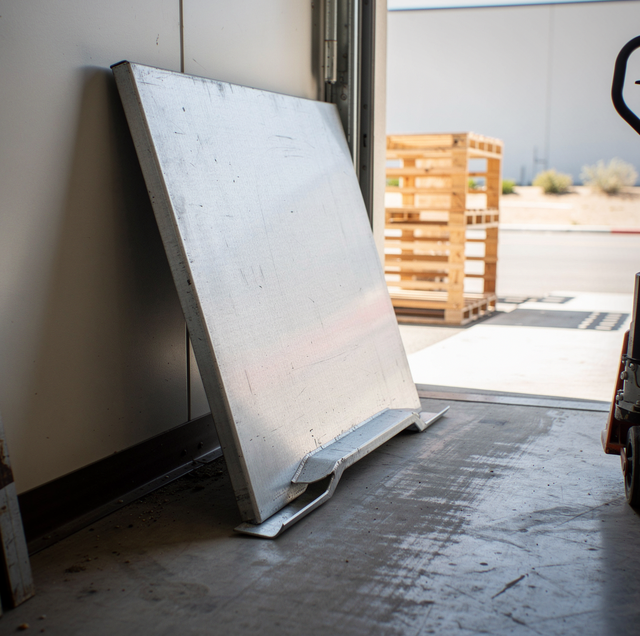
A dock plate is the one piece of loading dock equipment that gets dragged into position, walked over a few hundred times, and then leaned against a wall. A leveler lives in a pit and lands on your service schedule because it is bolted to the building. A loose steel plate belongs to no bay, and the damage it picks up between your shifts is easy to miss.
That matters because the plate is doing the leveler's job. It carries a loaded wheel across an opening with a drop under it, held down by nothing but its own weight and two legs. Everything a pit and a hydraulic cylinder do for a leveler, you ask one sheet of metal to do at your busiest opening.
A Dock Plate Is Loose Equipment Sitting Under a Loaded Wheel
A dock plate is a flat sheet of steel or aluminum, slightly bent at each end so that a wheel rolls on without catching. It has no motor, no pit, and no fixing to the building. A worker lays it across the space between dock floor and trailer bed, the load crosses, and the plate comes off. Two details do all of its safety work: legs on the underside that drop behind the dock face and stop the plate creeping forward, and handles or lifting loops for moving it. Everything else is a piece of metal carrying a wheel, with open air beneath the middle, which is why a plate you can pick up still counts as structural equipment.
Dock plate repair is central to safe and efficient loading dock operations. Damaged plates create safety risks and delays; professional repairs restore structural integrity and a stable connection between the dock and vehicles, and regular maintenance and timely repairs prolong equipment life. Structural integrity and a stable connection are properties of the plate itself, and both can be compromised while the plate still looks usable, even when leaning against your wall. Neither is visible across the bay.
A plate that has to be moved belongs on a forklift, because a heavy steel plate dragged by hand can slide off the dock lip and fall onto a worker's feet.
Dock Plate and Dock Board: The Curbs Explain the Capacity Gap
The two look alike from ten feet away, and the difference is why plates bend. A dock board is a plate with steel curbs along its edges, and that structural addition is why its capacity runs as high as 20,000 pounds, compared to 17,000 for a plate. A plate has no curbs, and plates are built for hand carts, hand pallet jacks, and foot traffic, not for use with power equipment.
The distinction goes missing in a busy shipping office. A driver grabs whichever plate is nearest and runs a powered pallet jack over it instead of walking a hand truck across, and the steel takes a load it cannot spread. A plate with no pins or legs also does not lock to the dock or trailer the way a board can, so the misapplication that overloads your deck also removes the one thing holding it. You then have power equipment on a plate with nothing anchoring it.
Dents, Cracks, and Bent Components on a Portable Dock Plate
Visible damage on this equipment includes dents, cracks, or bent components, and it can be traced back to impacts or excessive stress. That kind of wear is more than cosmetic: it can indicate deeper structural issues that, if left unaddressed, can lead to catastrophic failure. On a portable plate, that point is unusually literal, because there is no frame, no pit, and no secondary support to take over when the steel gives up.
Three patterns are worth knowing on the daily walk-around. A dent in the running surface means the plate has already yielded under a wheel, and yielded steel does not return to its original shape. A crack at a leg weld or a handle bracket means the attachment that stops the plate sliding is holding on with less material than it started with, which nobody discovers until the day it lets go. A curled or mushroomed edge means the ends have been hammered by wheels crossing at an angle, and a curled end raises the ramp your operator has to climb, so each load lands harder than the last. You can see all three of them from standing height.
Why a Bent Plate Stops Seating Flat Against the Dock Lip
Permanent set is the failure mode that makes a plate dangerous while it still looks serviceable. Steel loaded past its yield point never springs back level; it keeps a shallow bow, and that bow lifts the middle of the plate off the surfaces it should rest on. What was full contact along two straight edges becomes contact at a few high points, so the load path narrows to whatever the steel happens to touch. The plate then rocks under a wheel, and rocking is not a nuisance you can live with. Each rock is a small horizontal shove against the dock face, walking the plate toward the opening a fraction at a time and shortening the overlap that supports the far end.
Trailer movement finishes what rocking starts, and a plate carries no defense against it. Restraint equipment exists as a separate service for that reason, and a creeping trailer is a restraint problem for your technician.
Gaps between dock and truck, uneven lifting, and difficulty securing vehicles are all alignment symptoms, and a bowed plate produces all three. Engagement is confirmed before the first load crosses, because the first crossing is when a shifted plate finds your gap.
What Takes a Dock Plate Out of Service for Good?
Some damage is repairable, and some ends the plate's working life, and the line between them is a technician's judgment with the plate in hand. Cracks are the clearest case. A crack in the deck or at a leg weld has already formed a stress concentration, and it will keep finding it under every subsequent load. Bent or missing legs are the second case, because those legs are the only thing between the plate and the opening it bridges. A running surface worn smooth is the third, since traction across the transition is part of what the plate was bought to provide.
Permanent set is the harder call, and the honest test is whether the plate lies flat on the dock floor with no weight on it. A plate that rocks on level concrete has lost its geometry for good. Length, width, height, and capacity all have to suit the application, which means a plate that has changed shape no longer matches the dimensions it was chosen for. A capacity marking worn illegible belongs in the same category, because you cannot match a load to a rating nobody can read, and your operators will assume the plate is fine.
Fitting Plate Checks Into a Scheduled Preventive Maintenance Program
Scheduled dock maintenance already covers the pit equipment. The Gold plan runs four visits a year and the Silver plan two, both greasing moving parts, sweeping out pits and surrounding areas, making minor adjustments, and closing with an assessment of parts and a replacement recommendation. Gold adds thorough inspection and testing of dock operations.
A portable plate sits in no pit, so it joins the visit only if somebody lists it, and your regular dock and door inspection schedule covers the rest of the equipment. The plate is the one piece you can add to that list yourself.
Frequently Asked Questions
It depends where the bend is and how it got there. A shallow bow in a thick deck may be correctable in a shop with a press, while a plate that has yielded around a crack or weld is finished. You want that call made off the dock, with your plate unloaded and its legs visible to you.
Hand carts, hand pallet jacks, and foot traffic. Dock plates are not intended for use with power equipment; that duty stays with curbed dock boards. So if you run a powered jack across a plate on your busiest bay, you have misapplied the equipment, and the deck will show it as a bow long before the plate fails outright.
No. An edge-of-dock unit bolts to the face of your dock and pivots in place, while a plate is loose equipment that comes out, gets positioned, and goes back into storage. They bridge the same space, so you will hear the names used interchangeably, but only one of them can be misplaced.
Flat, and off the traffic route. A plate leaned against a wall can be knocked onto somebody, and one left in a drive aisle collects the impacts that bend it. A rack keeps your plates flat and clear of your reversing trucks, where you see them.
The person about to cross it. A dock plate has no controls and no interlock, so your pre-use check is a human one: legs behind the dock face, both ends fully overlapping, no rock underfoot, no visible crack. Anything failing goes out of service, and your supervisor picks what you run instead of that plate.
The standard interval for this kind of equipment is every 3 to 6 months, depending on usage and environmental conditions. Both halves of that guidance are doing real work at your dock. Usage pushes a busy cross-dock toward the short end, because every trailer you handle is another set of loaded crossings over the same piece of steel. Environmental conditions push the same way where hardware lives in dust, wash-down water, or corrosive air, since a plate losing section to corrosion is quietly losing the capacity your operators still count on.
A dock plate that rocks underfoot or shows a cracked leg weld belongs in front of a technician — book a dock plate repair and have the plate written into the same scheduled visit that covers your levelers and seals. Prime Dock & Door LLC serves La Mirada, Anaheim, and Santa Ana. Call (714) 683-2201.
