

What Is a Truck Restraint — and Why Your Dock Needs One
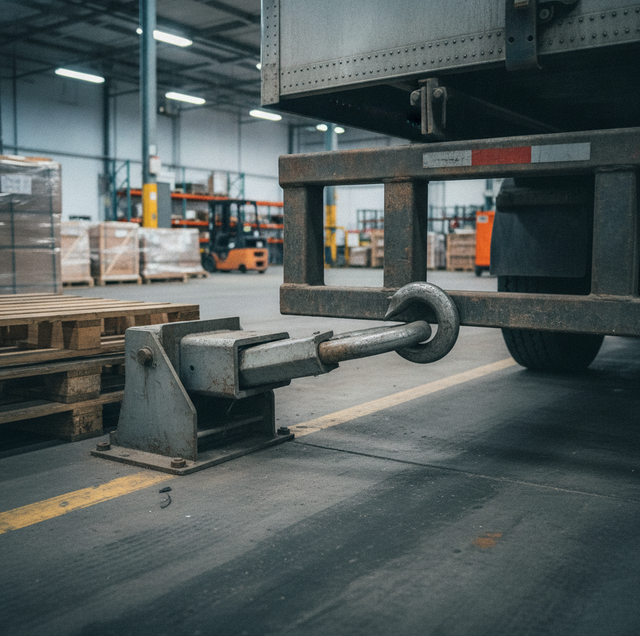
Quick Answer: A truck restraint (also called a vehicle restraint or dock lock) is a device mounted at the loading dock that physically secures a parked trailer to the dock so it cannot drift, creep, or pull away while a forklift is loading or unloading. Most engage the trailer's rear impact guard (the RIG or ICC bar) with a rotating hook or barrier; others engage the wheels when a trailer has no usable guard. A restraint prevents trailer creep, early departure, landing-gear collapse, and dock separation, the failures that drop a forklift into the gap. It is far more reliable than wheel chocks, which can slip, and it usually ties into a red and green communication light system so the driver and dock crew know when it is safe to move.
Every time a forklift rolls off your dock and into a trailer, it puts several thousand pounds of momentum against a truck that is only parked, not anchored. A wheel chock and a driver's good intentions are all that hold it in place, until they don't. A truck restraint replaces that trust with a physical lock between the trailer and the dock, and it is the single piece of equipment that stands between a normal load cycle and a forklift dropping into the gap. If you run a busy dock and have never looked closely at what secures your trailers, this is the part worth understanding.
What a Truck Restraint Actually Is
A truck restraint is a device installed at the loading dock that mechanically secures a parked trailer to the dock so it cannot move away during loading and unloading. You will also hear it called a vehicle restraint, a trailer restraint, or a dock lock, same equipment, different names. It mounts to the face of the dock wall or to the driveway directly in front of the dock, and in some layouts, it is recessed below the dock so it stays clear of the drive.
Most restraints work by engaging the trailer's rear impact guard, the horizontal steel bar across the back of the trailer, known as the RIG or the ICC bar. That guard is a federally required feature on trailers over 10,000 pounds, meant originally to stop a car from sliding under a trailer in a rear collision, and its consistent position makes it the natural thing for a restraint to grab. A rotating hook or a rising barrier swings up, catches the guard, and holds the trailer against the dock until the operator releases it. That single mechanical connection is what turns a "parked" trailer into a "secured" one.
The Failures It Is Built to Stop
The reason a restraint exists comes down to four specific ways a trailer can betray a loading crew, and each one ends the same way: a gap opening between the trailer and the dock while someone is working across it.
The first is trailer creep, sometimes called dock walk. Every time a forklift accelerates into the trailer and brakes on the way out, it transfers momentum to the trailer, nudging it forward in tiny increments. Over a load cycle, those nudges add up, and the trailer inches away from the dock. The lip of the dock leveler that bridges the gap can lose its support, and the forklift ends up crossing an opening that grows with every pass.
The second is early departure, a driver pulling away while the crew is still loading, whether from a miscommunication, a language barrier, or simply not knowing anyone is still inside. The third is landing-gear collapse, where the front supports of a parked trailer fail or sink under the weight of a loaded forklift, dropping the nose and shifting the whole trailer. The fourth is dock separation, the general term for the trailer parting from the dock for any reason. In each case, a restraint that has the RIG hooked keeps the trailer where it belongs instead of letting it roll.
Why a Restraint Beats Wheel Chocks
Plenty of docks still rely on wheel chocks, wedges shoved in front of the trailer tires. Chocks are cheap and better than nothing, but they carry weaknesses that a restraint does not. A chock only works if a driver places it, places it correctly, and places it on a surface that holds. On ice, on a greasy or oily drive, or on loose gravel, a chock can slide or roll out of the way under the same momentum a forklift generates, and chocks routinely get lost, kicked aside, or skipped when a driver is in a hurry.
A truck restraint removes that human variable. It is operated from the dock by your crew, not by a driver who is eager to leave, and it makes a positive mechanical connection to the trailer's structure rather than relying on friction against the pavement. That is the core difference: friction can fail quietly, but a hook around a rear impact guard either engages or it does not.
How the Light System Coordinates the Dock and the Driver
A restraint on its own holds the trailer; a communication light system is what keeps everyone reading the same signal. Most restraints tie into a set of red and green lights, one set facing the driver outside and one facing the dock crew inside. When the restraint is engaged, and it is safe to load, the crew sees a green light inside; the driver sees a red light outside telling them to stay put. When loading is complete and the restraint releases, the signals flip (red inside, green outside), indicating it is finally safe to pull out.
This closes the exact gap that causes early departures. Instead of a driver guessing whether the crew has finished, or a worker shouting across a noisy dock, both sides act on the same unambiguous signal. Amber lights are sometimes added to flag a caution state, such as a restraint that has not fully locked onto the guard.
When the Rear Impact Guard Is the Problem
Because so many restraints depend on the RIG, a trailer with a bad guard is where things get complicated. A rear impact guard can be missing entirely, bent from a previous impact, rusted and weakened, or built to a nonstandard height or shape that a hook cannot reach or trust. Some trailers (lift-gate units, small city-delivery trucks, and certain specialty trailers) either lack a usable guard or block access to it.
For those trailers, a hook-style restraint may not get a safe bite, and forcing it can give a false sense of security. The alternative is a wheel-engaging restraint, which secures one or more of the trailer's tires instead of the guard. A dock that handles a mixed fleet often needs to think about both styles rather than assuming every trailer that backs in will present a clean, standard RIG.
Manual Versus Powered Restraints
Restraints come in manual and powered versions, and neither is automatically the right answer. A manual, or mechanical, restraint is engaged and released by the operator, often with a rod that moves the hook into position by hand. It costs less and has fewer parts to service, which suits a lower-volume dock or a facility watching its budget. The tradeoff is that it depends on a person doing it every time, correctly.
A powered restraint (usually hydraulic or electric) engages at the push of a button or automatically as part of an integrated dock sequence. It takes the effort and much of the judgment out of the operator's hands, which pays off at a high-traffic dock cycling trailers all day. Powered units generally pair with automatically sequenced lights, so the restraint and the signals move together. The right pick depends on how many trailers you turn, how consistent your fleet is, and how much you want to remove operator error from the equation.
The Restraint as Part of the Dock System
A restraint does not work alone. It sits at the front of a system that also includes the dock leveler, which bridges the height difference between the dock floor and the trailer bed, the dock bumpers that absorb the trailer's impact and set its stopping distance, and the door and seal that close the opening. The restraint's whole job is to keep the trailer still so the leveler's lip stays supported and the crossing stays flat.
That interdependence matters for upkeep. Bumpers that are worn or crushed let a trailer park too close or too far, which can push a RIG out of the restraint's reach, and a failing leveler hides the early symptoms of creep. Treating the restraint as one link in a chain (inspected and serviced alongside the leveler, bumpers, and seal) keeps the whole dock dependable rather than fixing one piece while another quietly drifts out of spec.
Keeping a Restraint Reliable Over Time
A restraint earns its place only if it works every cycle, and that takes maintenance. The hook or barrier, the pivot points, and any hydraulic or electrical components wear with use, and a dock in a coastal or marine environment sees salt-laden air attack the steel and speed up corrosion. A restraint that has rusted, bent, or lost hydraulic pressure may look engaged while holding far less than it should, the most dangerous failure mode, because it hides.
Regular inspection means checking that the hook fully engages and releases, that the lights match the restraint's real state, and that nothing has corroded or bent enough to compromise the bite. When a restraint stops locking reliably, or the lights fall out of sync with it, that is a repair to make before the next trailer backs in, not after an incident forces the issue.
Frequently Asked Questions
Trailer creep, sometimes called dock walk, is the trailer inching away from the dock as it's loaded. Each time a forklift drives in and brakes, it hands its momentum to the trailer, and those small shoves add up until a gap opens under the leveler lip. Two things you may not expect make it worse: a trailer on air-ride suspension flexes and shifts under the moving load, and a trailer dropped off its tractor rests only on its landing gear and kingpin with no brakes holding it. A restraint stops all of this by locking the rear impact guard to the dock, and better barrier-style units ride up and down with the trailer as its suspension works, staying engaged instead of popping loose as the bed rises and falls.
Chocks rely on friction with the pavement and on a driver placing them right every time, so on ice, oil, or gravel, they can slide out under forklift momentum, and they get lost or skipped. A restraint makes a positive mechanical connection to the trailer and is run by your dock crew, not a driver who wants to leave. Worth knowing: the two aren't strictly either-or. Plenty of operations run a restraint as the primary hold and still chock the wheels as a backup, so a single failure doesn't set the trailer free, and a trailer dropped off its tractor also gets its landing gear supported or a stand placed under the nose. The restraint removes friction and human weakness; the chocks stay on as cheap redundancy.
It replaces guesswork with one shared signal: when the restraint is locked, the driver sees red outside, and the crew sees green inside, and the colors swap when it releases, so the driver knows it's finally safe to pull out. On better-integrated docks, the lights are only part of it. The restraint can be interlocked with the dock so the leveler or the overhead door won't operate until the restraint is engaged, and the sequence can't reverse until it's safely released. Some setups add an audible alarm and posted signage for the same reason, and an amber light to flag a restraint that hasn't fully seated. The point is to take a driver's judgment about when to leave out of the equation entirely, since a driver pulling out mid-load is a leading cause of dock separation.
Without one, the dock leans entirely on a chock and the driver's awareness, which exposes you to early departure, landing-gear collapse, and trailer creep, any of which can drop a loaded forklift and its operator into the gap. Part of what makes it dangerous is that the dock leveler bridges the early stages of creep and hides them, so the crew doesn't notice the trailer drifting until the gap is already wide. A facility that isn't ready to install fixed restraints can cut the risk in the meantime with quality wheel chocks used correctly, a glad-hand lock that keeps a coupled trailer's brakes from being released, and strict communication rules, but those are stopgaps, not a substitute for a device that physically anchors the trailer to the building.
Hook-style restraints need a sound guard sitting in the height range they're built to catch. The bar has to fall within a fairly narrow window off the ground for the hook to get a safe bite, and a guard that's bent, rusted, missing, or built to a nonstandard height can sit outside it. Forcing a hook onto a weak or out-of-position guard is worse than not trying, since it can look engaged while holding almost nothing, and it can finish bending a guard that was already failing. Lift-gate trailers and small city-delivery trucks often have no usable guard at all. For those, a wheel-engaging restraint that grabs a tire is the answer, which is why a dock serving a mixed fleet usually needs both styles, plus the habit of eyeballing the guard's condition before trusting the hook.
No, a working restraint speeds up safe turnaround rather than slowing it. A powered unit engages with a button push in seconds and the light system replaces the shouting and hand signals that actually waste time at a busy dock. Because the crew is not stopping to place and verify chocks or to confirm the driver understands, the load cycle stays moving while the trailer stays locked. The time a restraint costs is trivial next to the downtime a single dock incident causes.
Where the Restraint Fits in Your Operation
A truck restraint is not an accessory bolted onto the dock; it is the component that makes everything else at the dock safe to do. It holds the trailer still so the leveler can bridge a stable gap, it coordinates with the lights so nobody moves at the wrong moment, and it does the one job a wheel chock can only pretend to do, anchoring the trailer to the building rather than trusting the pavement. For a facility running trailers in and out all day, the question is less whether a dock needs one and more whether the one it has still locks the way it should.
Not sure your dock's trucks are actually secured? — Get your truck restraints, levelers, and lights inspected and repaired so every trailer locks the way it should. Prime Dock & Door LLC serves La Mirada, Anaheim, and Santa Ana. Call (714) 683-2201.
