

Why Is My Rolling Steel Door Sticking or Binding?
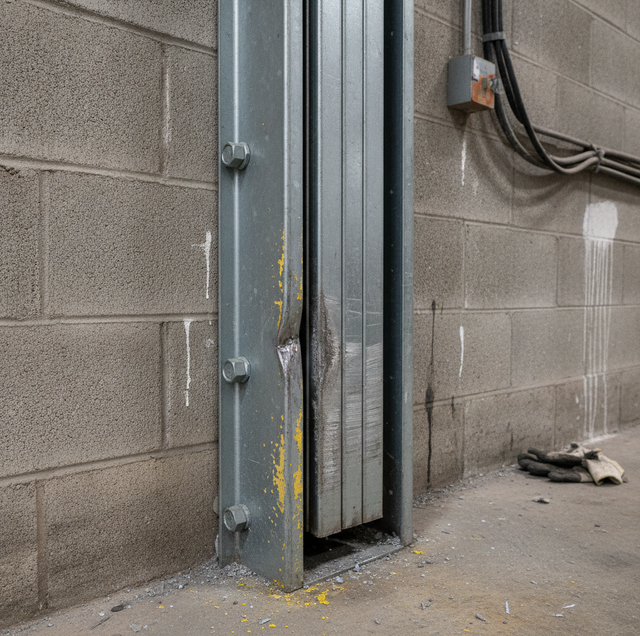
You hit the button, the curtain starts up, and partway through the travel, it hesitates, drags, or catches hard enough that you back off and hit it again. On a commercial rolling steel door that cycles all day, that hesitation is mechanical feedback: something in the path has moved, worn, or corroded enough to fight the door. Ignore it, and the drag you feel this week becomes a curtain jammed halfway up next week, usually mid-shift when a truck is waiting. Sticking has a short list of causes, and each one leaves a tell that points you to what needs attention.
Where a Rolling Steel Door Actually Binds
A rolling steel door works because the steel curtain rides up two vertical guides while a counterbalance barrel overhead does most of the lifting. When the guides are clean and true, the barrel bearings turn freely, and the counterbalance spring inside the barrel holds the right tension, the curtain rolls with little effort. The binding starts when one of those falls out of tolerance. The curtain then drags across a rough surface, catches on a warped spot, or feels heavy throughout its entire travel because the barrel is no longer carrying its share. Finding the fault means reading where the resistance shows up, because the location and pattern of the bind narrow the cause fast.
The Common Culprits
Most sticking traces to a handful of wear points that repeat on high-cycle commercial doors.
Worn end bearing plates sit at each end of the barrel and carry the rotating shaft. As those bearings wear, the barrel drops or cocks slightly off its axis, so the curtain no longer feeds squarely into the guides and drags the whole way. A bent or impacted guide is the next usual suspect: a forklift clip or a pallet strike deforms one section of guide, and the curtain catches at that exact height every cycle. Corroded or bone-dry guides add friction along the entire run, so the door feels rough top to bottom rather than stuck at one point. A counterbalance spring that has lost tension leaves the curtain heavy, since the barrel is meant to offset most of the steel's weight, and a weak spring makes the door labor through the lift. Loose hood or bracket hardware lets the assembly shift out of position so the curtain rubs where it should clear.
| What You Notice | Likely Cause |
|---|---|
| Drags the whole travel, curtain feeds crooked | Worn end bearing plates |
| Catches at the same height every cycle | Bent or impacted guide |
| Rough and gritty top to bottom | Corroded or dry guides |
| Heavy to lift, labor through the whole run | Counterbalance spring lost tension |
| Rubs or rattles are used to clear | Loose hood or bracket hardware |
Why a Small Bind Turns Into a Shutdown
A binding curtain does not stay the same; the fight it puts up wears the parts that keep it moving. A door dragging against a bent guide or riding on a failing bearing loads the counterbalance spring, the operator motor, and the brackets harder every cycle. Push a heavy curtain through a worn barrel long enough, and you turn a drag into a curtain that stalls, then into one that will not clear the header at all. On a loading dock, a door stuck open is a temperature and security problem, and a door stuck shut is a truck that cannot load. Catching the bind while it is still a drag keeps the fix on your schedule instead of an after-hours emergency call.
How Coastal Salt Air Speeds the Wear
A door near the coast lives in salt-laden air that works on bare steel year-round. That marine air corrodes the barrel bearings, the guides, the springs, and the fasteners, pitting surfaces that need to stay smooth and seizing parts that need to turn. A door on the coast tends to bind sooner than the same door inland, because corrosion is quietly roughening the exact contact points where the curtain rides. Keeping the guides and hardware clean, protected, and correctly lubricated slows it down, and regular inspection catches a corroding bearing or a rusting spring coil before it locks the door. This is not a seasonal issue; the salt is in the air in January and July alike.
Frequently Asked Questions
Reach for a light-penetrating oil or a dry-film lubricant designed for door hardware, and apply it to the metal you have already wiped clean. Skip heavy grease and sticky chain oil: in a dusty warehouse, those thick products act like flypaper for airborne grit, and the sand and dust they trap turn into an abrasive paste that scores the guides, the slat edges, and the barrel journals a little more with every cycle. A door that grabs worse right after someone greased it is usually caked with contaminated lube, not starved of it. When you lubricate, less product wiped to a thin film outlasts a heavy coat.
Look first at the bottom bar, the reinforced angle across the base of the curtain that the slats hang from. A strike from a forklift mast or a pallet corner can bow that bar or kink the lowest slats, and a bent bottom bar drags or wedges in the guides near the floor, even when the rest of the curtain looks fine. Because the damage sits where loads move in and out, it takes hits the upper curtain never sees. A bowed bottom bar or a few crumpled slats need straightening or replacement, not lubricant, since forcing the door only spreads the deformation up the curtain.
No. The counterbalance spring is wound to hold the weight of the whole steel curtain, so it stores enough energy to break bones or worse if it slips off the winding bars. Releasing or tightening that tension calls for the correct bars, a locked barrel, and training, which is a technician's job, not a maintenance shortcut. If the door only feels heavy, note that for the tech, and never stand in the curtain's path or under the barrel while testing a door you suspect has a spring problem.
The lifting mechanism changes what a bind feels like and where the fault hides. On a hand chain-hoist door, resistance travels straight to your hands, so you feel the exact spot the curtain fights and can stop pulling before you force it; a worn hoist chain or a slipping reduction gear can also mimic a stuck curtain. A motor-operated door hides that feedback behind the operator, and the binding may actually sit in the operator's clutch, brake, or limit settings rather than the curtain. When a powered door hesitates or the motor labors, have the operator itself checked alongside the guides and barrel.
Listen and watch for a change in how it runs. A door heading toward a jam usually gets louder, grinds or squeals where it used to run quiet, hesitates or stutters at one point in the travel, or makes the operator strain audibly near the top of the lift. A curtain that has started tracking toward one guide, or a hesitation that lands at the same height and worsens week to week, is warning you before it stalls. Those signs mean stop cycling it and get it inspected; a door that merely feels a touch stiff has more runway than one that has started making new noises.
The bill shows up as downtime, not a repair line. A dock door stuck shut halts loading and unloading at that bay, so trucks idle, drivers wait, and product backs up until the door moves again, and a door stuck open leaves the building open to weather and anyone walking past. On a busy dock where several bays run in sequence, one jammed door can stall a whole shift's flow. That lost throughput is why scheduled service on the barrel, spring, and guides is worth far more than the parts it replaces.
What to Do When the Door Starts Sticking
A rolling steel door sticks because worn end bearing plates, a bent guide, corroded or dry hardware, a tired counterbalance spring, or loose brackets have put resistance in a path that should be clear, and each of those leaves a pattern you can read from where and how the curtain catches. If the door is dragging but still cycling, stop forcing it: every cycle you push it through the bind wears the parts faster and raises the odds of a full jam at the worst moment. Note whether it drags the whole way or catches at one height, whether it feels heavy or gritty, and get it inspected before the drag becomes a stall.
If your rolling steel door is sticking or binding, we can find the cause and fix it before it jams your operation. Prime Dock & Door LLC serves La Mirada, Anaheim, and Santa Ana. Call (714) 683-2201.
